Editor’s Note: CMTS is proud to partner with the Mark Twain Forum, which has long been a leading venue for reviews of new publications in Mark Twain Studies. Visit their extensive archive.
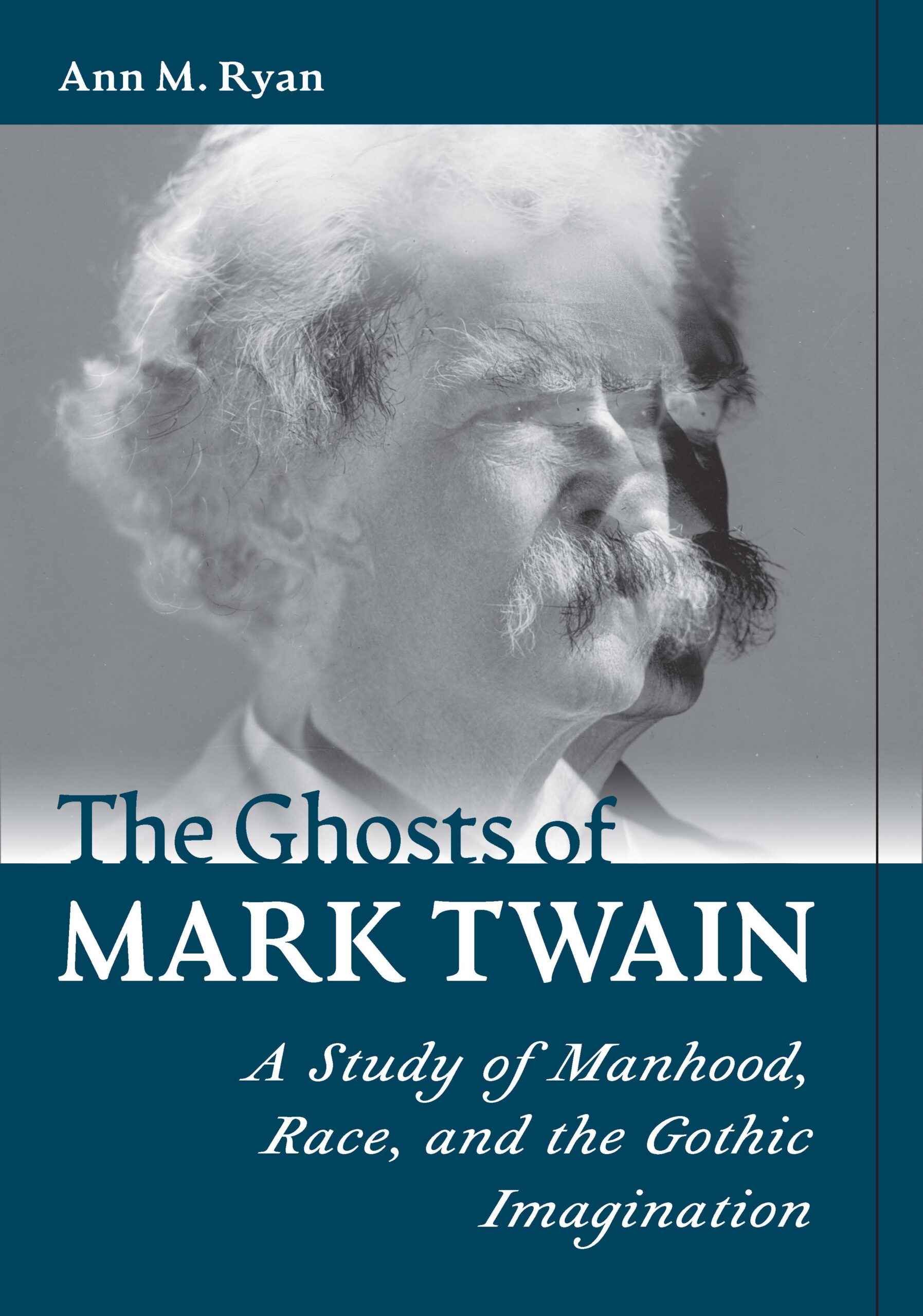
The Ghosts of Mark Twain: A Study of Manhood, Race, and the Gothic Imagination. Ann M. Ryan. Columbia, Mo: University of Missouri Press, 2025. 277 pp. $55, ISBN 978-0826223425.
Reviewed for the Mark Twain Forum by Susan K. Harris, Hall Professor emerita, University of Kansas
The two aspects of Clemens/Twain on which Ryan focuses are gender–especially white manhood–and race, especially black manhood. The new perspective is the aesthetics of the gothic, which she defines as “ghost stories: haunted houses, forgotten crimes and memories, the longing for redemption, the shifting perspectives of victim and villain” (p.4). To these elements she brings a flood of supporting materials: prior scholarship, cultural patterns, theoretical insights,
historical events, literary criticism, and Twain’s own autobiographical writings. Throughout, she emphasizes both Twain’s own myth-making of himself and the public’s myth-making of “Mark Twain,” including biographers (especially Paine), and editors. Her interest is in how Samuel Clemens’s “ghosts” enter into, and shape, “Mark Twain’s” characters, especially white and black men. While the “structures, themes and tropes” appear in much of his published work, she claims, central gothic elements appear most prominently in uncompleted narratives, discarded fragments. “In these scraps and remnants, Twain wrestles with the American history of racism, which he finds intertwined with the history of his own family,” she suggests (4). The literary debris itself functions as a kind of ghost, both personal and cultural.

Ann M. Ryan
The four main chapters of the book develop the intersections of black and white manhoods that Ryan perceives. Chapter one, “The Ghost of John Marshall Clemens,” begins with Twain’s memory of having been, as a toddler, left behind by his father when his family left his birthplace in Florida, Missouri, to move to Hannibal. Noting that there are multiple versions of this story but that all center Twain’s father as the parent who forgot his son, Ryan begins to weave it into her own fabric, moving quickly from the autobiographical anecdote to the loneliness and fear of ghosts expressed by the fictional character Huckleberry Finn; from Huck to Tom Sawyer, lying in bed haunted by the spectre of a vengeful Indian Joe; and from there to Tom Driscoll’s furious confrontation with his own racial identity. In each fictional case, Ryan argues, the “haunting” of white male characters involves their sense of complicity in racial crimes: the fact that Jim is a slave at all; that Tom Sawyer knows how cruelly the white town has treated Indian Joe; that Tom Driscoll understands how his own past behaviors have come to haunt him. One of the aspects that make this study as good as it is is that Ryan rarely presents these gothic tropes and structures as merely personal or strictly literary; rather, she consistently moves from the private sphere of Twain’s personal history to the cultural manifestation of which Twain’s fears are a part. Cold, self-absorbed, and brutal white men are paired with angry, vengeful, men of color. Even white men who present as kindly to other whites (Judge Thatcher, Judge Driscoll) turn brutal when crossed bythe Other. Thus the white men who enslave, oppress, beat, trade, and pursue men and women of color in the name of Justice and Property are, for Twain, symptoms of an American culture of which he knows he is an inextricable part. And therein lies the conundrum: Samuel Clemens knew that not only had he inherited the guilt of his forebearers, he was also, by virtue of his whiteness, complicit in the ongoing oppression against black Americans that was being waged, by and large, by white men.
Chapter Two, “The Ghost of Daniel,” focuses on performance itself, exploring Twain’s rewriting of stories told by Daniel Quarles, “Uncle Dan’l,” –a charismatic story-teller owned by Sam’s uncle John Quarles–into his own repertoire, especially “The Golden Arm.” As she had brought Twain’s wife, Olivia Langdon, into Chapter One, here Ryan brings in their daughters: Susy, Clara, and Jean, as each girl responds to her father’s stage presence and especially to his recitation of “The Golden Arm,” with its shouted ending calculated to make his audience jump. This chapter has dual foci: on the one hand, it is largely about story-telling, its art and practice by Daniel Quarles, then as appropriated by Twain and by Joel Chandler Harris. With this, it also probes white writers’–including Twain’s–propensity to present black characters as caricatures, and how that shaped, and was shaped by, post-bellum white perceptions of the black people. The other focus of the chapter deals with memory and myth-making, especially the rewriting of plantation life in the post-bellum South. Twain’s memories, an intrinsic part of his story-telling, played a part in this revisioning; his descriptions of Mississippi river life, of life on his Uncle Quarles’ farm, and of the kindly, loving figure of Daniel Quarles himself, became iconic during this period. But, Ryan points out, Twain’s memories of antebellum idyls were also balanced by his memories of antebellum brutalities, such as an incident when a white man, angered by a slave’s clumsiness, threw a brick at his head and killed him. Thus the gothic–the resurrection of memories of criminal brutalities–intertwines with the construction of a “Lost Cause” South.
room, a fear his master dismisses as “foolishness.” Establishing this discarded version of Jim as a fearful, quaking, black man, Ryan moves to another manifestation of this caricature, the minor figure of Nat at the end of Adventures of Huckleberry Finn, a man so gullible and superstitious as to be taken in by Tom Sawyer’s pranks. Arguing that here Twain is “reducing” the figure of the historical Nat Turner into a “buffoon,” Ryan suggests that the result is the revision of the story of Turner’s rebellion into a joke. But the whites gathered at the Phelps’s farm are not a joke; believing, falsely, that a slave insurrection is imminent, they are openly vocal about their plans to physically, and brutally, punish all black people in retaliation. The chapter concludes with a history of lynching, and Twain’s decision to write, but not publish, “The United States of Lyncherdom,” an essay demonstrating that Twain still harbored fears of black male masculinity even while condemning white lawlessness and brutality.
Chapter Four, “The Ghost of Sam Clemens,” and the brief Epilogue that follows it, first, explore Twain’s late, mostly fragmentary, “stranger” manuscripts, and then, in the Epilogue, “Mark Twain’s” afterlife in biographies, editions, impersonators, and popular myth-making. As she has done throughout the book, Ryan here pulls on contemporary cultural currents, especially the late nineteenth century’s fascination with spirits–mesmerism, spirit-rapping, “ghost writing,” and psychic phenomena of all kinds. Twain, despite his innate skepticism, shared the fascination; his specific interest was in thought-transfer, but he listened to narratives of spirit manifestations, and he and Olivia, in the wake of Susy’s death, did try their luck at contacting her through a medium. The cultural fascination with spirits, however, mostly appears in Twain’s writings, especially in sketches and manuscript fragments composed during his last fifteen years. Of these, Ryan singles out, rightly, the collection that has come to be titled The Mysterious Stranger Manuscripts, and among those, especially, the roughly completed manuscript “#44, The Mysterious Stranger.” These she approaches through Twain’s ongoing interest in the play between fact and fiction in all story-telling. Twain was keenly aware of the subjectivity of all narratives; Ryan particularly focuses on the word “As” in his 1874 sketch “A True Story As I Heard It,” where the white narrator claims to be recording a black woman’s life story. Here the ‘as’ implies that the author can only filter the story through his white construction of blackness. Ryan reads it as signaling Twain’s understanding that his own position as a white male makes it impossible for him to truly convey the depth of “Aunt Rachel’s” pain. From this relatively early sketch Ryan moves to some of the late sketches and manuscript fragments that feature “strangers,” truth-tellers, who reveal, or attempt to reveal, painful truths to audiences unable to comprehend what they are hearing. Her reading of “#44, The Mysterious Stranger,” brings together all the gothic elements she has hitherto explored; a haunted castle, a mysterious stranger, ghost or duplicate selves, invisibility, and historical brutalities, culminating in the narrator’s (another of Twain’s young males) discovery that he is the origin of all stories, all histories. Advising him to “dream other dreams, and better,” Twain’s final stranger disappears, leaving the narrator, like the infant Sam Clemens, abandoned, alone in an empty universe where the only haunted house is his own creative consciousness. Here the ghost doubles back on the story-teller, a horrifying revelation of his own (white, male) innate propensity for violence. The ghost that terrifies, it turns out, is oneself.
The Ghosts of Mark Twain: A Study of Manhood, Race, and the Gothic Imagination, touches all the bases: rigorous research, deep familiarity with relevant texts, a novel perspective, and a fluid, lucid, writing style. I not only found it a pleasure to read, but it has given me new windows through which to view both Mark Twain’s life and writings and current American and international events. I could not recommend it more highly.
Copyright © 2026 Mark Twain Forum. This review may not be published or redistributed in any medium without permission. The Mark Twain Forum Review Editor is Barbara Schmidt.