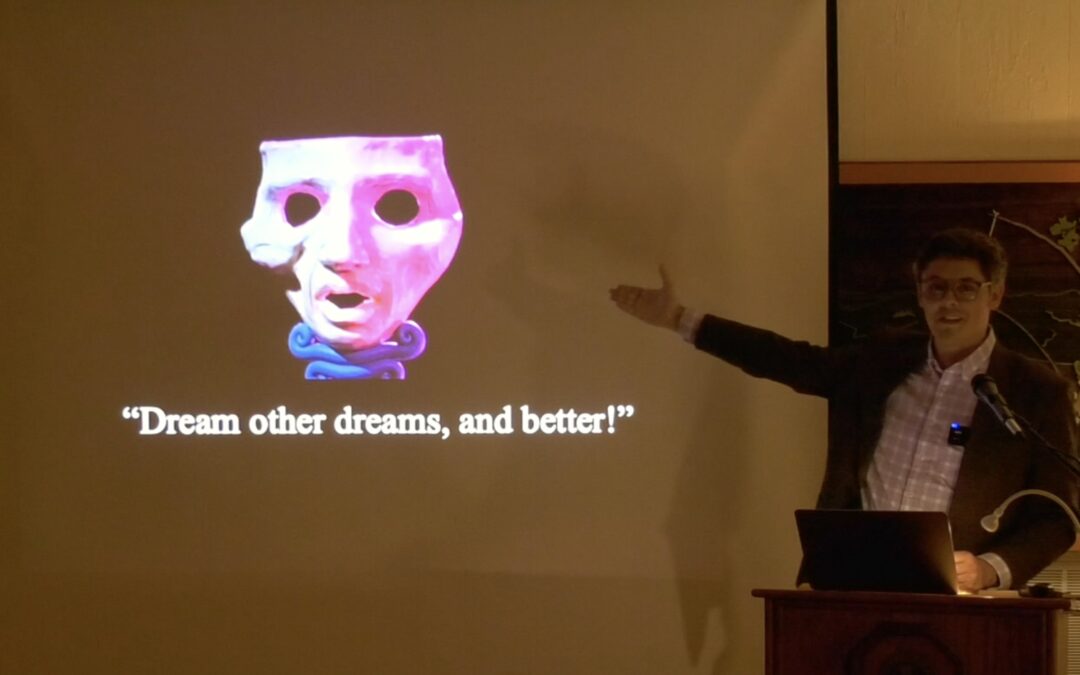
The Center for Mark Twain Studies (CMTS) at Elmira College concluded 2026 Fall Trouble Begins Lecture Series last night. The lectures took place on Wednesdays throughout October at Quarry Farm. Located at 131 Crane Road (Elmira), the lectures are free and open to the public.
Ray Horton presented “The Mundane Transcendence of Mark Twain’s Late Style.” Horton is Associate Professor of English at Murray State University.
When Hank Morgan purports to blot out the sun to escape execution in A Connecticut Yankee in King Arthur’s Court, he does so under a presupposition that Max Weber would come to codify as one of modernity’s maxims: “the world is disenchanted. One need no longer have recourse to magical means in order to master or implore the spirits…Technical means and calculations perform the service.”[1] While the people of Camelot remain enthralled to Merlin’s magic and the church’s mysteries, Hank promises to secularize the sixth century with a “New Deal,” a rationalized political economy for a newly disenchanted world. Throughout the novel, Hank’s naturalistic account of human progress and knowledge becomes its own kind of gospel, the good news of disenchantment that Hank’s missionaries begin to spread throughout a benighted Medieval Europe. Thus, it seems that A Connecticut Yankee in King Arthur’s Court, anticipating much of Twain’s later writing, might serve as an exemplary illustration of what scholars of religion and literature have taken to calling the “secularization thesis,”[2] the presupposition that modernity’s rise equals religion’s fall.
For much of the twentieth century, the standard view of Twain’s trajectory as an author seemed to mirror the secularization thesis: Twain’s increasingly disenchanted, naturalistic worldview coincided with what Hamlin Hill infamously called “the junkyard of unfinished manuscripts” that accumulated toward the end of Twain’s life—the death of the author’s “creative control over his world” resembling, in miniature, the death of God. Over the past two decades, however, Twain scholarship has challenged the caricature of the late Mark Twain as, in Hal Bush’s words, an “alienated, grief-ridden curmudgeon shaking his fist at God.”[3] Concurrently, Twain scholars have tended to reconsider Hill’s criticism of Twain’s late work as a mere “junkyard,” bringing newfound attention to fragmentary and posthumously published works such as The Great Dark, Letters from the Earth, and the Mysterious Stranger manuscripts.
In this talk, I argue that the religious and aesthetic challenges presented by Twain’s later work are, in many ways, co-constitutive. Far from being the disjointed flotsam of a disenchanted mind coming to grips with a disenchanted age, much of what we find in Twain’s later work resembles the phenomenon Edward Said, following Theodore Adorno, called “late style,” a rejection of “harmony and resolution” for “intransigence, difficulty, and unresolved contradiction.”[4] Twain’s late style, furthermore, is less invested in the simple repudiation or recovery of the religious impulse than is often supposed; rather, it strives toward what philosopher William E. Connolly calls “mundane transcendence,” an effort to “overcome resentment of the world for not possessing either providence or ready susceptibility to human mastery.”[5] To imagine transcendence in the aftermath of disenchantment—or, as the divine emissary of No. 44, The Mysterious Stranger enjoins, to “dream other dreams, and better!”—requires, for Twain, a more tenuous, fragmentary approach to what No. 44 describes as the “dreams, visions, fictions” of the fragile, finite vision that dominates Twain’s later writing.[6]
Ray Horton is an Associate Professor of English at Murray State University and was named the “2023 College Teacher of the Year” by the Kentucky Council of Teachers of English. He was a 2025 Quarry Farm Fellow at the Center for Mark Twain Studies, and he currently serves as President of the American Religion and Literature Society. His work has appeared in PMLA, Christianity & Literature, LIT: Literature, Interpretation, Theory, and Post-45. His book project in progress, tentatively titled “American Fiction’s Secular Faith,” examines the relationship between aesthetic attention and religious experience in American fiction from the late nineteenth century to the present, spanning from Mark Twain to Marilynne Robinson.
[1] Max Weber, “Science as a Vocation.” 1919. From Max Weber: Essays in Sociology, ed. Charles Wright Mills and Hans Gerth, 1946 (New York: Routledge, 2009), 129-56.
[2] See, for instance, Michael Kaufmann, “The Religious, the Secular, and Literary Studies: Rethinking the Secularization Narrative in the History of the Profession,” New Literary History 38.4 (2007), 607-627.
[3] Harold K. Bush, Mark Twain and the Spiritual Crisis of His Age, (U of Alabama P, 2007), 255.
[4] Edward Said, On Late Style: Music and Literature Against the Grain (Pantheon, 2006), 7.
[5] William E. Connolly, “Belief, Spirituality, Time,” The Immanent Frame (2008), accessed May 12, 2025, http:// tif.ssrc.org/2008/04/17/belief-spirituality-and-time/
[6] Mark Twain, No. 44, The Mysterious Stranger, in Mark Twain: The Mysterious Stranger Manuscripts, ed. William M. Gibson (U of California P, 2005), 405.