Past Quadrennial Conferences and Symposia
Since 1989, the Center for Mark Twain Studies has hosted The International Conference on the State of Mark Twain Studies. This quadrennial gathering is devoted to advancing and exploring the State of Mark Twain Studies. The Conference takes place on the Elmira College campus and at Quarry Farm. Hundreds of scholars and enthusiasts from around the globe gather to study and celebrate the life of Sam Clemens and the literature of Mark Twain, constituting the world’s largest scholarly conference focusing on Mark Twain and his literature.
Starting in 2008, the Center for Mark Twain Studies has hosted a number of symposia on specific topics in Mark Twain Studies These symposia offer scholars the opportunity to spend a few days deeply delving into a specific aspect of Mark Twain Studies. Several speakers, usually experts in their specific academic field, give papers throughout the gathering, often followed by roundtable discussions.
The Thirteenth Quarry Farm Syposium “Black Childhood and Children’s Literature in the Nineteenth Century”
Friday, October 16 & Saturday, October 17, 2026
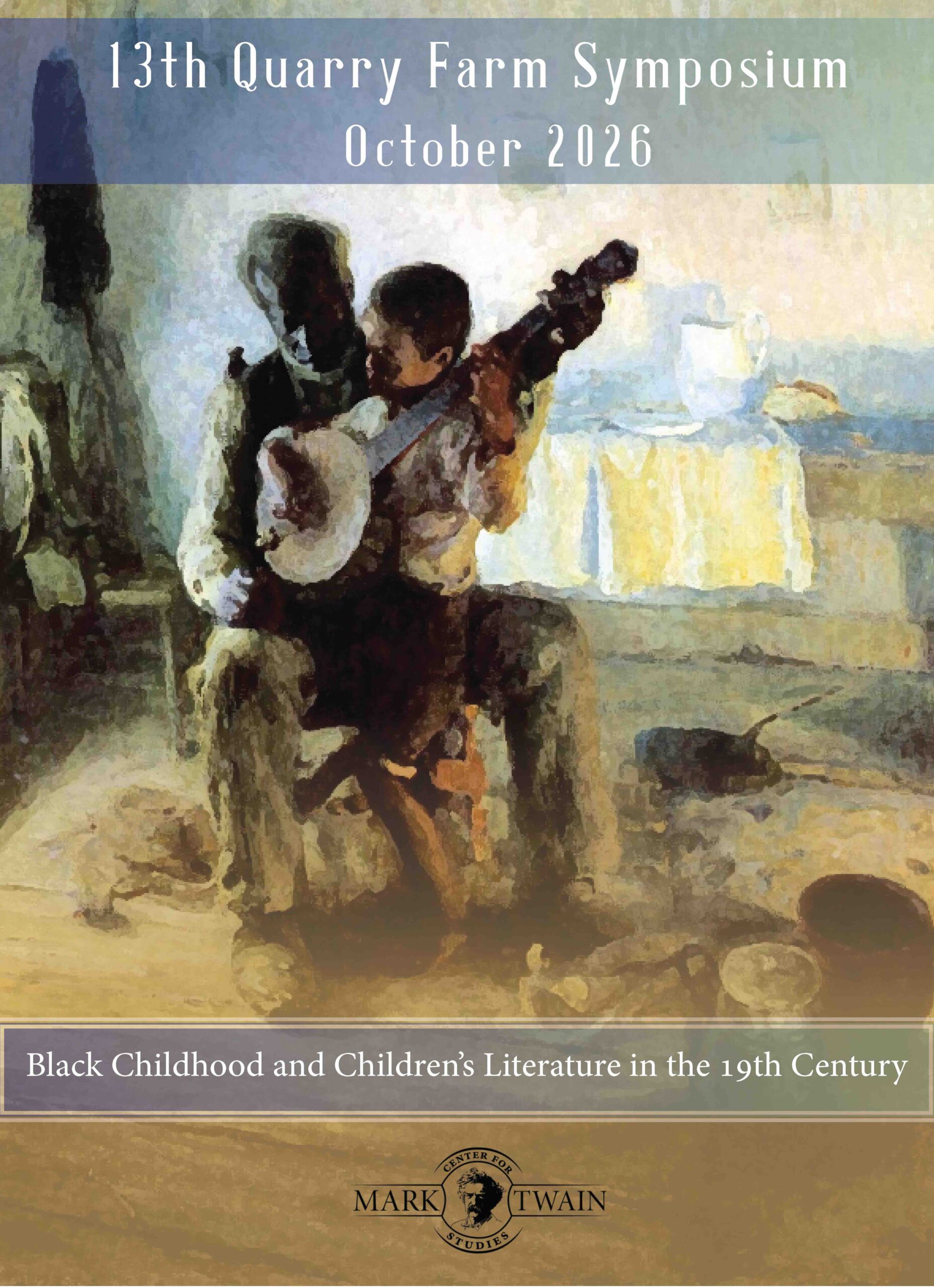
The thirteenth Quarry Farm Symposium took place on the property where Twain wrote most of his iconic works. Like previous symposia on, for instance, Abolition Studies and Energy Studies, the “Black Childhood and Children’s Literature in the Nineteenth-Century” symposium does not seek to center Mark Twain or his works in the proceedings, but merely to acknowledge that ongoing research and publication in this field is bound to facilitate better understanding of Twain’s life, work, legacy, and world, as is CMTS’s mission. Twain imagined the literary characters Tom Sawyer and Huckleberry Finn at Quarry Farm and these iconic representations of childhood have contributed to white children’s overrepresentation in American popular culture. Considering Black childhood in the nineteenth century adds essential context for understanding childhood during this era.
The Sympoisum Chair and Organizer was Professor Brigitte Fielder (University of Wisconsin-Madison).
The kenote event consisted of an interview of Marcus Kwame Anderson (illustrator) and David F. Walker (writer), the creators of Big Jim and The White Boy: An American Classic Reimgined (2024).
The following consists of most of the papers presented at the symposium:
- Marcus Kwame Anderson, Brigitte Fielder, and David F. Walker, “Big Jim and the White Boy: An American Classic Reimagined: A Conversation” (Quarry Farm Library – October 16, 2026) KEYNOTE EVENT
- Denise Burgher, “Black Boys Play with Toys: Alice Dunbar Nelson and Black Boyhood in her short story ‘His Heart’s Desire’” (Quarry Farm Barn – October 17, 2026)
- Katharine Capshaw, “Envisioning the 19th Century for Children of the Harlem Renaissance” (Quarry Farm Barn – October 17, 2026)
- Sarah E. Chinn, “‘A Jolly Crew’: Black Drummer Boys and the Right to Mischief” (Quarry Farm Barn – October 17, 2026)
- Allison Curseen,“‘Little Fairy Devils’: Reading A Poetics of Mobility in Memories of Childhood’s Slavery Days” (Quarry Farm Barn – October 17, 2026)
- Brigitte Fielder, “School Songs and Black Futures: Joshua McCarter Simpson and Eductional Uplift” (Quarry Farm Barn – October 17, 2026)
- Norrell Edwards, “Fighting Racism in a Zombie Apocalypse” (Quarry Farm Barn – October 17, 2026)
- Tabitha Lowery, “Teaching Rest and Resilience: Harper, Dunbar, and the Moral Imagination in The Dunbar Speaker and Entertainer (1920)” (Quarry Farm Barn – October 17, 2026)
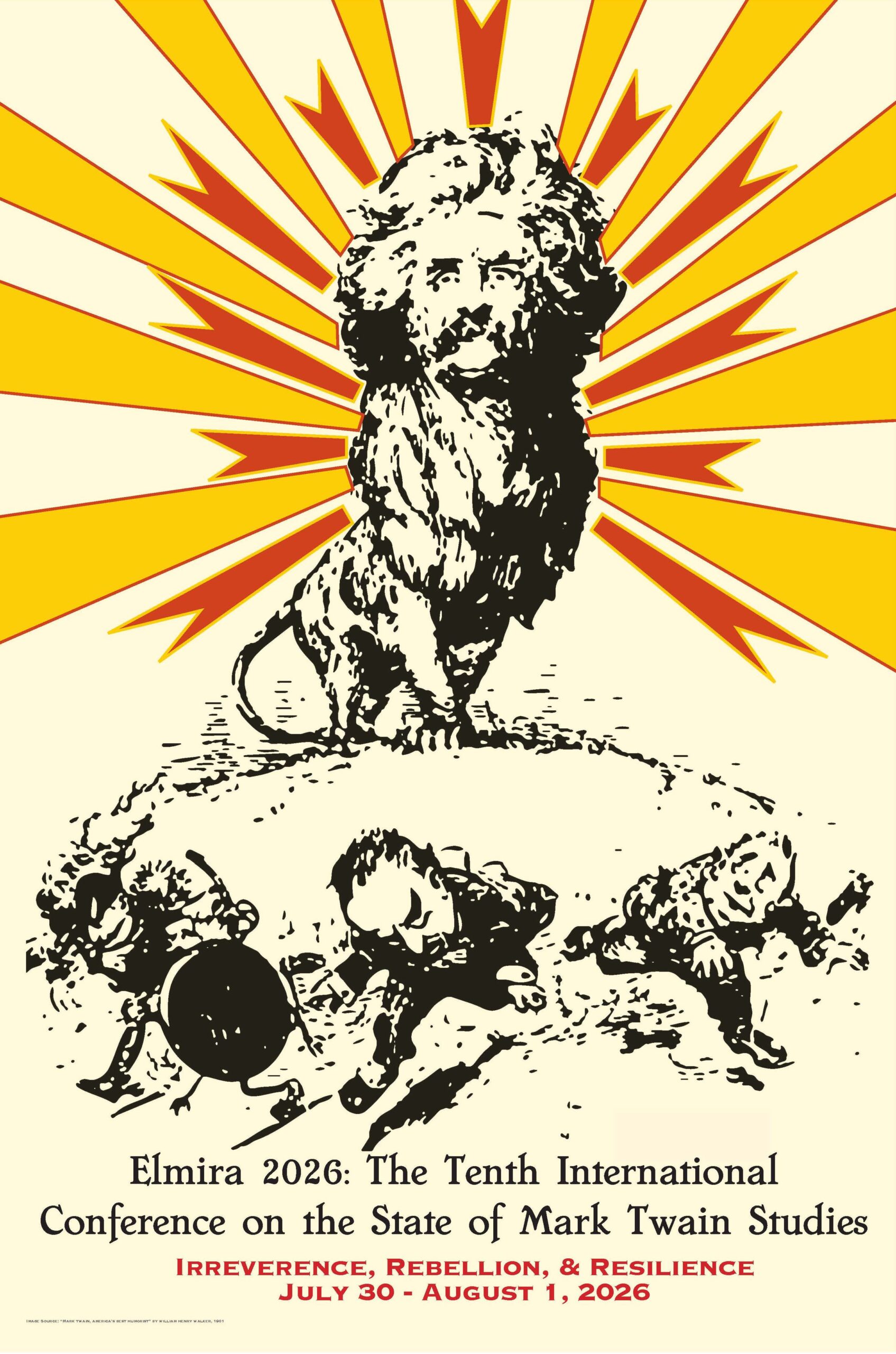
Elmira 2026: The Tenth International Conference on the State of Mark Twain Studies
Thursday, July 30 – Saturday, August 1, 2026
The theme of the conference was “Irreverence, Rebellion, and Resilience.” Highlights of Elmira 2022 included 60 delivered papers; 5 special panels; a live recording of the Amercian Vandal Podcast, featuring Lauren M.E. Goodlad, Jeff Jarvis, and Matt Seybold; and a keynote event featuring a conversation with Kerry Driscoll and Robert Hirst, both from the Mark Twain Papers and Project.
Center for Mark Twain Studies collaborated with the following groups and organizations for Elmira 2026:
- Mark Twain Circle of America
- American Humor Studies Association
- Literature/Film Association
- 2022 Quarry Farm Symposium “Abolition Studies”
- 2023 Quarry Farm Symposium “Science Fiction, Invention, and Technology”
- 2024 Quarry Farm Symposium “Gilded Age Humor”
- 2025 Quarry Farm Symposium “Energy Studies”
The following are a portion of the papers presented during the conference. (Click on the scholar’s name for a video recording of the talk)
- John Bird, “Irreverent Humor on Death and Dying: Mark Twain’s ‘The Undertaker’s Tale'” (July 31, 2026 – Elmira College Campus)
- Zsanna Mária Bodor, “‘Extinction in the Smoke-Clouds of the Stake’: Evolution and Ecogothic in Mark Twain’s Personal Recollections of Joan of Arc” (July 31, 2026 – Elmira College Campus)
- Gregg Camfield, “Is He Dead?” (August 1, 2026 – Elmira College Campus)
- David Carlyon, “Why Send Huck to a Circus? Why Bind Jim?” (July 30, 2026 – Elmira College Campus)
- James Caron, “Marietta Holley and the Gilded Age Women’s Movement” (July 31, 2026 – Elmira College Campus)
- Kerry Driscoll, “‘Not for sin but for sentiment – and stupidity’: Mark Twain’s Brief (and Unhappy) Association with the Connecticut Prisoners’ Friends’ Society” (July 30, 2026 – Elmira College Campus)
- Dwayne Eutsey, “‘I don’t take no stock in dead people’: Mark Twain’s Holy Irreverence” (July 31, 2026 – Elmira College Campus)
- Kaine Ezell, “‘Showing Off’ for Who?: Twain’s Analysis of Spiritual Motivation in The Adventures of Tom Sawyer“
- Edward Guimont, “Twain, Astronomy, and Speculative Fiction” (July 30, 2026 – Elmira College Campus)
- Anjalee Gunaratnam, “Latimer’s Matter: The Decomposition of Self, Hegelian Dialectics, and George Eliot’s Physics of Sympathy in ‘The Lifted Veil'” (July 30, 2026 – Elmira College Campus)
- Ryuzo Hamamoto, “An Unrealized Connection between Japan and Twain: Hannah Riddell’s Letter and Its Transnational Context” (August 1, 2026 – Elmira College Campus)
- Harold Hellwig, “Connecticut Yankee and Innocents Aborad: Catholicism and Antithesis; Pilgrimage, Conversion, Reverence, and Betrayal” (August 1, 2026 – Elmira College Campus)
- Robert Hirst, “Looking Back, Looking Forward” (July 31, 2026 – Elmira College Campus) KEYNOTE EVENT
- Kumi Ikoma, “The Defiant Daughter and the Silent Father: ‘Wapping Alice’ and Susy Clemens” (July 31, 2026 – Elmira College Campus)
- Holger Kersten, “Jim in a New Light: Revisiting Huckleberry Finn Illustrations in American and German First Editions (July 30, 2026 – Elmira College Campus)
- Takuya Kubo, “Biocultural Reading of Huckleberry Finn: Huck’s Oscillation between Body, Thought, and American Dichotomies” (July 30, 2026 – Elmira College Campus)
- James W. Leonard, “Enumerating Myth: ROUGHING IT and the Disorder of Things (August 1, 2026 – Elmira College Campus)
- Kevin Mac Donnell, “Mark Twain’s Black Muse: The Life and Legacy of His Butler, George Griffin” (July 31, 2026 – Elmira College Campus
- Kotaro Nakagaki, “Dictating Grief: Writing as Mourning in Mark Twain’s Autobiography” (July 31, 2026 – Elmira College Campus)
- Terry Oggel, “Twain and Tesla: The Twain Shall Meet” (July 30, 2026 – Elmira College Campus)
- Nicholas Otranto, “Mark Twain and American Belonging” (July 30, 2026 – Elmira College Campus)
- Susan Poulson, “Love, Marriage, and Murder: Samuel Clemens and the Perils of Passion” (July 31, 2026 – Elmira College Campus)
- Patrick Prominski,“The Microscopist and Mark Twain: Expanding Twain’s Elmira Social Circle and Influence on ‘The Great Dark'” (July 30, 2026 – Elmira College Campus)
- Stephen Rachman, “Thinking Fast and Slow: Daniel Kahneman and Mark Twain’s ‘How To Tell A Story'” (July 31, 2026 – Elmira College Campus)
- Alan Rankin, “In Their Right Minds: Livy, Clara, Nina, and ‘Americanitis'” (July 31, 2026 – Elmira College Campus)
- Jeanne Campbell Reesman, “The ‘Australasian Spartans’ of Tasmania: Classical Allusion as Satire in Following the Equator“
- Laura Rice, “From Twain to Trump: A Genealogy of Incivility” (August 1, 2026 – Elmira College Campus)
- Ann Ryan, “Cowards, Critics, and the Untold True Story of ‘The United States of Lyncherdom'”
- Jeff Steinbrink, “Quantum Failure and Gunplay in Huck Finn“
- Todd Nathan Thompson, “‘Siberia,’ Rechristened ‘Future’: Imaginative Mapping Meets Imperial Anxiety in Gilded Age Humor” (July 31, 2026 – Elmira College Campus)
- Hillary Warolin, “Transmediality and Adaptation: Moby-Dick and Tom Sawyer” (July 30, 2026 – Elmira College Campus)
Twelfth Quarry Farm Symposium, “Energy Studies”
Friday, October 10 & Saturday, October 11, 2025
In a 2011 PMLA Editor’s Column “Literature in the Ages of Wood, Tallow, Coal, Whale Oil, Gasoline, Atomic Power, and Other Energy Sources” Patricia Yeager asked what might happen if, rather than organizing literary history by segments of chronological time (historical periods) or intellectual movements (the history of ideas), “we sort texts according to the energy sources that made them possible?” Since that time, Energy Studies has burgeoned across humanistic disciplines, as scholars have examined sources of energy not just as the material substrate fueling the modern world but as the basis of social, political, economic, and cultural arrangements. This symposium seeks papers that explore cultural dimensions of energy across the long duree of what Jamie Jones has termed “fossil modernity,” from the eighteenth century to the present.
Papers might consider particular energy regimes and forms (coal, oil, gas, solar), energy’s shifting meanings over time (energy as metaphor and energy as substance), energy’s key terms (extraction, abundance, exhaustion, depletion, transition), its effects (growth, velocity, violence, pollution), its infrastructures (from pipelines to refineries and data centers), and its relations to ongoing historical processes (racialization, settler colonialism, capitalism). The symposium hopes to take stock of “energy” and Energy Studies’ past and their possible futures.
This is the 12th Quarry Farm Symposium, hosted by the Center For Mark Twain Studies on the property where Twain wrote most of his best-remembered works. Like previous symposia on, for instance, Abolition Studies and American Literary History & Economics, the Energy Studies symposium does not seek to center Mark Twain or his works in the proceedings, but merely to acknowledge that ongoing research and publication in this field is bound to facilitate better understanding of Twain’s life, work, legacy, and world, as is CMTS’s mission. Twain wrote explicitly, in The Gilded Age (1873), for instance, about steam and oil as epochal commodities. He worked in mining encampments and over fossil-powered machinery throughout the transformative decades of the 1850s and 1860s. He belonged to labor unions and advocated for industrial laborers. And, later in life, he variously defended, derided, organized against, and invested in what we would now recognize as energy companies, including Standard Oil.
The following are papers presented at the symposium:
- April Anson, Alexander Menrisky, and Matt Seybold, “Everyday Ecofascism” Keynote Event (October 10, 2025 – Tifft Lounge, Elmira College)
- Rachel Banner, “Marital Entropy: Domestic Science & Domestic Violence at the Dawn of Thermodynamics” (October 11, 2025 – Quarry Farm Barn)
- Elizabeth Barrios, “Boom, Bust, and Infrastructure Failure: Latin American Energy Humanities” (October 11, 2025 – Quarry Farm Barn)
- Brent Bellamy, “The Aesthetic Textuality of Oil” (October 11, 2025 – Quarry Farm Barn)
- Kathryn Dolan, “Mining Gilt: Interrogating the Search for Coal in The Gilded Age” (October 11, 2025 – Quarry Farm Barn)
- Jeffrey Insko, “How to Shut Down a Pipeline” (October 11, 2025 – Quarry Farm Barn)
- John Kendall, “Abstracting the Earth: Seismic Prospecting, Fossil Capital, and the Political Economy of Geoscience” (October 11, 2025 – Quarry Farm Barn)
- Caroline Levine, “Collective Forms” (October 11, 2025 – Quarry Farm Barn)
- Alexis Schmidt, “American Exhaustion: Reading Turn-of-the-Century Literature through Energy Studies” (October 11, 2025 – Quarry Farm Barn)
- Caleb Wellum, “The ‘Energy Gap’ and the Practice of History” (October 11, 2025 – Quarry Farm Barn)
- Nathan Wolff, “Extremely Violent and Perilous Weather: On Puddn’head Wilson and Hydropower” (October 11, 2025 – Quarry Farm Barn)
Eleventh Quarry Farm Symposium, “Gilded Ages: Humor, Literature, and Society”
The event focused on a wide range of subjects related to numerous aspects related to the Gilded Age, including literary humor; political cartoons; social satire; periodical humor; visual arts; contemporary representations of the Gilded Age; gender, race, class and Gilded Age Humor; nationalism and transnationalism; and Mark Twain.
The keynote address was presented by Nathan Wolff Associate Professor at Tufts University and author of Not Quite Hope and Other Political Emotions in the Gilded Age (Oxford University Press, 2019). A special issue of the peer-reviewed journal Studies in American Humor will focus on the proceedings from the event.
The following are papers presented at the symposium:

- James E. Caron, “Marietta Holley’s Samantha Allen, Humorous Housewife, Satiric Suffragette” (October 12, 2024 – Quarry Farm Barn)
- Christopher J. Gilbert, “Dear God, Let Us Praise Mark Twain’s Satanic Sense of Humor” (October 12, 2024 – Quarry Farm Barn)
- Lawrence Howe, “Skewering Gilded Age Corruption: The Visual Satire of Thomas Nast” (October 12, 2024 – Quarry Farm Barn)
- Charline Jao, “Mark Twain’s False Alarms” (October 12, 2024 – Quarry Farm Barn)
- Teresa Prados-Torreira, “The Comic Lecturer in the Gilded Age” (October 12, 2024 – Quarry Farm Barn)
- Stephen Rachman, “Buying Siberia: Fraud, Speculation, and Revolution from The Gilded Age to The American Claimant” (October 12, 2024 – Quarry Farm Barn)
- Ann M. Ryan, “Gilding Jim and Nat: Mark Twain and the Specter of the Angry Black Man (October 12, 2024 – Quarry Farm Barn)
- Matt Seybold, “Colonel Sellers, Doc Rockefeller, & The Technofeudal Enclosure of Everything” (October 12, 2024 – Quarry Farm Barn)
- Bruce Simon, ““Rereading Jim’s Coat of Arms: The Badge of Servitude and the Device of Race in Mark Twain and Nathaniel Hawthorne” (October 12, 2024 – Quarry Farm Barn)
- Barbara E. Snedecor, “‘She is the best girl in all the world’: Gilded Age Domestic Humor and Resilience in Olivia Clemens” (October 12, 2024 – Quarry Farm Barn)
- Kyhl Stephen, “Twain, Humor, and the Fashioning of Gilded Age Consumer Society” (October 12, 2024 – Quarry Farm Barn)
- Todd Nathan Thompson, “‘Mr. Seward’s Real Estate Transactions’: Comic Imperialism in the Reconstruction Era” (October 12, 2024 – Quarry Farm Barn)
- Nathan Wolff, “First as Farce: Structures of Feeling in The Gilded Age” 2024 Quarry Farm Symposium Keynote Address (October 11, 2024 – Elmira College Campus)
Tenth Quarry Farm Symposium, “Mark Twain: Invention, Technology, and Science Fiction”

Scholars have acknowledged that much of Twain’s work could be labeled “science fiction” if it were published today, an understanding that goes back at least as far as David Ketterer’s 1984 collection, The Science Fiction of Mark Twain. Twain’s writing appeared in the nineteenth-century literary marketplace side-by-side with dime novels about boy explorers in submarines or airships, hero-worshipping biographies of famous inventors, and the translated works of contemporaries like Jules Verne. Moreover, Twain embodies the straddling of popular success and cultural prestige that Rieder mentions; then and now, Twain’s career navigated these contradictions. Locating when and how Twain’s work fits the “science fiction” label can help us see the limits and utility of genre.
With all this in mind, this symposium worked to understand the “broader cultural history” Rieder mentions by placing Twain and his contemporaries within the cultural transformations of science and technology, and within the broad literary boundaries of science fiction. What do we learn if we look at science fiction through the lens of Mark Twain, or Mark Twain through the lens of science fiction?
The chair of the symposium was Nathaniel Williams (University of California, Davis). The keynote address was delivered by Shelia Williams, editor of Asimov’s Science Fiction.
The following are all the papers presented at the symposium (Click on the scholar’s name for a video recording of the talk)
- Nicole Amare and Alan Manning, “Twain to Twilight: Latter-day Saint Motifs in Fantasy and Science Fiction Writing (October 7, 2023 – Quarry Farm Barn)
- Max Chapnick, “Mark Twain vs. Christian Science and Empire” (October 7, 2023 – Quarry Farm Barn)
- Edward Guimont, “Shadow of the Comet: Celestial Speculation in Twain’s Lifetime” (October 7, 2023 – Quarry Farm Barn)
- Anjalee Gunaratnam, “Aliens of Our World: Nineteenth-Century Naturalists in H.G. Wells’s The Time Machine and John Clare’s Bird Poems” (October 7, 2023 – Quarry Farm Barn)
- James D. Keeline, “Tom Swift and His Photo Telephone and H. Gernsbeck and E. Ruhmer and the Telephot” (October 7, 2023 – Quarry Farm Barn)
- Ronny Litvack-Katzman, “Science Fiction and Boundary of Genre” (October 7, 2023 – Quarry Farm Barn)
- Judith Yaross Lee, “Responses to Todd Nathan Thompson and Chander Shekhar: Technology and Imperialism in Mark Twain’s Novels” (October 7, 2023 – Quarry Farm Barn)
- Bruce Michelson, “AI and Technological Seductions of Mark Twain’s World” (October 7, 2023 – Quarry Farm Barn)
- Patrick Prominski, “‘The Diamond Lens’ and Fitz-James O’Brien’s Imagined Order” (October 7, 2023 – Quarry Farm Barn)
- Matt Seybold, “The World-Empire” (October 7, 2023 – Quarry Farm Barn)
- Chander Shekhar, “Navigating Whites’ Utopia: An Active Reader’s Response to Puddn’head Wilson” (October 7, 2023 – Quarry Farm Barn)
- Todd Nathan Thompson, “Weapons of Mass Distraction: A Comic Genealogy of A Connecticut Yankee‘s Speculative Exceptionalism” (October 7, 2023 – Quarry Farm Barn)
- Sheila Williams, 2023 Quarry Farm Symposium Keynote Address (October 6, 2023 – Elmira College Campus)
Ninth Quarry Farm Symposium “Abolition Studies”

The Ninth Quarry Farm Symposium “Abolition Studies” sought to take an intentionally transhistorical approach to the field of abolition studies through panels and discussions that attend to the long duree of abolitionist thought, activism, and organizing from the 19th to the 21st centuries. While there is robust scholarship on movements to abolish chattel slavery in the US before 1865, and there is growing interest – both scholarly and popular – in late 20th- and 21st-century prison and police abolition, this symposium looked to explicitly bring these two historical epochs into conversation across what Saidya Hartman has called “the nonevent of emancipation” towards richer analysis of, for example, carcerality, rights, social and civil death, enclosure, and criminalization. The symposium was especially interested in presentations that rigorously trouble the very notion of continuity, recognizing both the persistence of what Douglas A. Blackmon has called “slavery by another name” as well as the continuing “acts of resistance and sabotage” against racial terror and carceral capture identified by Sarah Haley and others occurring in the decades of transition from the late 19th to the early 20th century. That is, it invited analysis not only of forces of capture but also of resistance.
With this long history of mechanisms of captivity and modes of radical resistance in mind, thesymposium emphasized the interconnecting relationship between abolitionist movements working against the enduring legacies of U.S. racism in carceral forms from the 19th to the 21st centuries. And in recognition of recent insightful work in the field of critical prison and carcerality studies by thinkers including Ruth Wilson Gilmore, Erica Meiners, Liat Ben-Moshe, Kelly Lytle Hernández, Harsha Walia, Savannah Shange, Luana Ross, Eric Stanley, and others, we seek to enrich understandings of how carceral logics and institutions develop and expand across time to iterate in ever greater spaces of both public and private life.
The co-chairs of the symposium were Jesse A. Goldberg (New Mexico Highlands University) and Nancy Quintanilla (California State Polytechnic, Pamona). The keynote address was delivered by Sarah Haley (Columbia University).
The following are most of the papers presented during the symposium. (Click on the scholar’s name for a video recording of the talk)
- Alex Alston, “Animal Afterlives: 19th Century Abolitionism & The Discourse of Species” (October 1, 2022 – Quarry Farm Barn)
- M. Cecilia Azar, “Liberating the Punchline: Abolitionist Practices in Running One Thousand Miles for Freedom” (October 1, 2022- Quarry Farm Barn)
- Srimayee Basu, “The Entanglements of Emancipation and Juvenile Discipline in the Early Black Prison Memoir” (October 1, 2022 – Online)
- Sarah Haley, “Gender and the Abolitionist Present” (September 30, 2022 – Elmira College Campus – Keynote Address)
- Christopher Paul Harris, “The Last President: Notes on Abolition and the (un)Making of the World System” (October 1, 2022 – Quarry Farm Barn)
- remus jackson, “‘This is the kind of society I’m looking for, anyway’: Krysta Morningstarr & The Radical Potential of Prisoner’s Comics” (October 1, 2022 – Quarry Farm Barn)
- LaVelle Ridley, “Imaginative Abolition, Political Life Writing, and Black Trans Feminist Blueprints” (October 1, 2022 – Quarry Farm Barn)
- Margarita Lila Rosa, “Riotous Women, Criminalization, and the Voyeuristic Press in 1890’s California (October 1, 2022 – Quarry Farm Barn)
- Matt Seybold, “Mark Twain, The Abolitionist” (October 1, 2022 – Quarry Farm Barn)
- Kia Turner & Darion Wallace, “Exploring Anti-Carceral Education: Towards Mapping and Historicizing Contemporary Educators’ Theory and Praxis in Abolitionist Terms” (October 1, 2022 – Quarry Farm Barn)
- Michelle Velasquez-Potts, “Slow Death and the Domestication of Indefinite Detention” (October 1, 2022 – Online)
Elmira 2022: The Ninth International Conference on the State of Mark Twain Studies
August 4-6, 2022
The theme of the conference was “Growth: The Most Rigorous Law of Our Being.” Highlights of Elmira 2022 included over 50 delivered papers; 6 special panels; the humorous and informative presentation “All The Twains Meet: The Film and TV Portrayal of Mark Twain” by nationally-known TV critics David Bianculli and Mark Dawidziak; and a keynote address by award-winning poet Jimmy Santiago Baca.
The following are a portion of the papers presented during the conference. (Click on the scholar’s name for a video recording of the talk)

- Jimmy Santiago Baca, “A Sense of Twain” (August 5, 2022 – Elmira College Campus – Keynote Address)
- Philip Bauer, “For the Sake of Growth: My Inconsistent Look at the Life of Jean Clemens” (August 4, 2022 – Elmira College Campus)
- Donald T. Bliss, “Mark Twain’s Ten Lessons for a Workable Democracy: Or, Keeping the Republic” (August 6, 2022 – Elmira College Campus)
- David Bordelon, “Huckleberry Finn and 21st Century Hucksters” (August 6, 2022 – Elmira College Campus)
- George Cabanas, “Avatar of God: Mark Twain versus the Moral Sense and the Implications for the Contemporary World” (August 4, 2022 – Elmira College Campus”
- Elizabeth Cantalamessa, “The Devil and Mark Twain” (August 6, 2022 – Elmira College Campus)
- James Caron, “Mark Twain Lying In Bed” (August 4, 2022 – Elmira College Campus)
- Rosie Click, “‘The [Real] American Game’: Twain’s Thoughts on Soft Imperialism in Cuba” (August 6, 2022 – Elmira College Campus)
- John Davis, “The Pursuit of Disappointment: Growth of Status and Growth of Delusion in ‘The $30,000 Bequest’” (August 5, 2022 – Elmira College Campus)
- Maggie E. Morris Davis, “‘[H]e realized the shabbiness of his own self’: Reading Children in Poverty in Twain’s Adaptation Network” (August 5, 2022 – Elmira College Campus)
- Mark Dawidziak, “Big River, Lighting Out for the Tonys” (August 4, 2022 – Elmira College Campus)
- M.M. Dawley, “‘Only dead men can tell the truth in this world’: The Growth of Mark Twain’s Anger” (August 6, 2022 – Elmira College Campus)
- Kerry Driscoll, “‘Talking is the thing’: Mark Twain’s Bold Experiment in Empowering Women’s Voices” (August 4, 2022 – Elmira College Campus)
- Shelley Fisher Fishkin, “How Hal Holbrook’s Understanding of Mark Twain Grew and Changed Over Time: The First Decade” (August 4, 2022 – Elmira College Campus)
- Harold Hellwig, “The Political Theater in Mark Twain’s Illustrated Works” (August 6, 2022 – Elmira College Campus)
- Aleksandra Hernandez, “Disgust, Contempt, and Animal Cruelty in Twain’s Later Writings” (August 6, 2022 – Elmira College Campus)
- Thomas W. Howard, “‘Two stories tangled together’: The Double Brain, Pudd’nhead Wilson and Those Extraordinary Twins” (August 6, 2022 – Elmira College Campus)
- Tsuyoshi Ishihara, “Time for Change: Mark Twain in US School Textbooks, 1950s-1960’s” (August 4, 2022 – Elmira College Campus)
- Takuya Kubo, “Mark Twain’s Failures as ‘Neglected Texts’” (August 5, 2022 – Elmira College Campus)
- Virginia Maresca, “‘Treachery on both sides’: Mark Twain’s Lessons to Modern America on White Victimhood” (August 6, 2022 – Elmira College Campus)
- Linda A. Morris, “Susy Clemens: The Final Years (1890-1896)” (August 4, 2022 – Elmira College Campus)
- L.Terry Oggel, “Mark Twain’s Pudd’nhead Wilson: The Tragedy of Nineteenth-Century American Race Law” (August 6, 2022 – Elmira College Campus)
- Alan Rankin, “Nina Gabrilowitsch: Actress, Writer, Photographer” (August 4, 2022 – Elmira College Campus)
- Matt Seybold, “Darnella Frazier’s Smartphone & Mark Twain’s Notebook: The Vigilante Origin of American Police (August 6, 2022 – Elmira College Campus)
- Jeff Steinbrink, “Of Time and Quantum Mechanics in Roughing It” (August 4, 2022 – Elmira College Campus)
- Mika Turim-Nygren, “Huckleberry Finn‘s ‘Effect of Indigeneity’: Native Erasure in Law and Literature” (August 4, 2022 – Elmira College Campus)
Eighth Quarry Farm Symposium “Mark Twain and The West: Celebrating the 150th Anniversary of Roughing It“
The Mark Twain Annual and the Center for Mark Twain Studies commemorated the sesquicentennial of Roughing It. The Annual will publish a special issue devoted to Mark Twain and the West in 2022. The Center for Mark Twain Studies held a Quarry Farm Symposium in honor of Twain’s famous book in 2021. Both the publication and the symposium examine Twain’s relationship to all aspects of the American West. The co-chairs of the symposium were Joseph Csicsila (Eastern Michigan University) and Ben Click (St. Mary’s College of Maryland).
This broad scope allows for critical examinations of Twain’s work as:
- Western regionalist writing
- Twain and indigenous peoples
- Twain and immigrant populations
- Commentary on the American frontier
- Twain and domestic travel
- Twain’s Western journalism
- The West as a shaping force on his development as an artist
- The circle of writers Twain encountered out West and their continued relationship
- Twain and contemporary Western writers

While Twain and the West has been the subject of numerous studies since the early twentieth century, the special issue and associated symposium seek to explore what in recent years has become somewhat forgotten territory in Twain’s fictive and nonfictive writings.
Bruce Michelson delivered the keynote address, “Mercurial Texts and Turbulent Times.” Bruce Michelson is the author of Mark Twain on the Loose and Printer’s Devil: Mark Twain and the American Publishing Revolution, as well as many articles and book chapters about Mark Twain and other writers. He is Professor Emeritus of American Literature at the University of Illinois, and a past president of the Mark Twain Circle of America and The American Humor Studies Association. A Contributing Editor at Studies in American Humor, he is also a Fulbright Ambassador, having received two fellowships from the Fulbright Program. His most recent work includes a translation of George Clemenceau’s writings on Claude Monet and the fine arts, and A Mark Twain Quartet, four one-act comedies about the family life of Sam Clemens.
The following are all the papers presented during the symposium:
- Blake Bronson-Bartlett, “The Wild Traces of Calaveras in Notebook IV” (October 2, 2021 – Quarry Farm Barn)
- James E. Caron, “Mark Twain’s Rival Washoe Correspondents: William Wright and J.Ross Browne” (October 2, 2021 – Quarry Farm Barn)
- Christopher Conway, “Postwestern Crossings in Phong Nguyen’s The Adventures of Joe Harper (2016) and Robert Coover’s Huck Out West (2017)” (October 2, 2021 – Quarry Farm Barn)
- Kerry Driscoll, “Mark Twain’s Masculinist Fantasy of The West” (October 2, 2021 – Quarry Farm Barn)
- Dwayne Eutsey, “‘Thick as Thieves’: Mark Twain and The West’s Spiritual Frontiers” (October 2, 2021 – Quarry Farm Barn)
- Sarah Fredericks, “Thumbing the Nose and Maligning the Turnip: Mark Twain’s Western Rhetoric of Insults” (October 2, 2021 – Quarry Farm Barn)
- Andrew Hebard, “Corruption and Reform in Mark Twain’s West” (October 2, 2021 – Quarry Farm Barn)
- Myrial Holbrook, “The Terra Comica between Mark Twain and Sherman Alexie” (October 2, 2021 – Quarry Farm Barn)
- B.Scott Holmes, “Roughing It from Missouri to Nevada Territory, The Journeys of Samuel L. Clemens and Richard F. Burton” (October 2, 2021 – Quarry Farm Barn)
- James Wharton Leonard, “Mark Twain’s Ambivalent Encounter with The Western Landscape” (October 2, 2021 – Quarry Farm Barn)
- Jeffrey Melton, “Nature and Mobility in Mark Twain’s Roughing It“ (October 2, 2021 – Quarry Farm Barn)
- Jeanne Campbell Reesman, “The Mountain Meadows Massacre, as Told by Mark Twain and Jack London” (October 2, 2021 – Quarry Farm Barn)
- Matt Seybold, “The Mail-Bag Bed of Empire: Roughing It & The Gossamer Network” (October 2, 2021 – Quarry Farm Barn)
- Todd Nathan Thompson, “‘WHY WE SHOULD ANNEX’: Reprints and Repercussions of Twain’s New York Tribune Letters on Hawai’i” (October 2, 2021 – Quarry Farm Barn)
- Alex Trimble Young, “‘The Vigorous New Vernacular’: The ‘Goshoot’ Episode and the Politics of Irony in Roughing It“ (October 2, 2021 – Quarry Farm Barn)
Seventh Quarry Farm Symposium “American Humor and Matters of Empire”

There, in line with recent studies of transnational American culture and scholarship on imperialism and postcolonial theory in many contexts, Lee suggests that imperialism can serve as a key concept to replace not only the outmoded nationalist theories of American humor dating to the 1920s and ’30s, but also the generic international theories too broad to capture its cultural work across many media, genres, and historical eras. In particular, she invites scholars to probe how the unequal transnational political relationships of imperialism have shaped the basic components (plot, character, incident), rhetorical conventions, and comic techniques underlying comic traditions in the United States. Three seem immediately important: colonial continuity with comic traditions drawn from those of previous European imperial powers (Britain, Spain, France, and the Netherlands), postcolonial discontinuity in comic traditions (such as vernacular humor) marked by anti-imperialist and anti-aristocratic ideologies grounded in the American Revolution, and neo-colonial hybridization of native, immigrant, and other national comic traditions through U.S. hegemony across the land and people of North America (and beyond) in the years since the 1787 Northwest Territory Ordinance initiated the thirteen former colonies’ expansion into Thomas Jefferson’s projected “empire of liberty.” After years in which scholarship on American humor splintered into so many distinct traditions of medium and identity that the cultural whole disappeared from view, a paradigm for American humor studies focused on matters of empire in the colonial, postcolonial, and neo-colonial strands of humor in the U.S. promises to braid their diverse themes, stock characters and plots, media, rhetorical conventions, and techniques into what Edward Said called a contrapuntal harmony.
CMTS’s Seventh Quarry Farm Weekend Symposium, organized by Judith Yaross Lee (Ohio University), offered analyses of comic works and practices in film, literature, graphic art, many media genres across the history of American humor with an eye to understanding the rhetorical and cultural significance of comic practices marked by colonial, postcolonial, and neo-colonial relations.
CMTS partnered with American Humor Studies Association, and a number of the presenters will be featured in a special issue of Studies in American Humor in 2021.
John Wharton Lowe delivered the keynote address, “Coyote’s Jokebook: Native American Humor and the Dismantlement of Empire.” John Wharton Lowe is the Barbara Lester Methvin Distinguished Professor of Southern Literature at the University of Georgia. He is author or editor of nine books, including Conversations with Ernest Gaines (1995), Jump at the Sun: Zora Neale Hurston’s Cosmic Comedy (1997), and Calypso Magnolia: The Crosscurrents of Caribbean and Southern Literature (2016). He has published widely on the humor of African American, Native American, Italian American, Southern, Asian American, and circumCaribbean literatures.
The following are all the papers presented during the symposium.
- Burrell, Jalylah, “‘Strange and Beautiful Country’: Era Bell Thompson’s Boundary-Crossing Humor” (October 3, 2020 – Online Video)
- Caron, James E., “Gender Matters: Addison and Steele’s Amiable Satirist as a Regime of Truth in Antebellum America” (October 3, 2020 – Online Video)
- Dickson-Carr, Darryl, “Apocalypse Always: The End of Empire in African-American Writing Since World War II” (October 3, 2020 – Online Video)
- Gilbert, Christopher, “The Issue with Empire and a Comic Stretch of the Imagination” (October 2, 2020 – Online Video)
- Haggins, Bambi, “Stand-Up Comedy & Survival” (October 2, 2020 – Online Video)
- Hennefeld, Maggie, “‘Tyranny at Home’: Feminist Slapstick Comedy on the Brink of Global Catastrophe” (October 3, 2020 – Online Video)
- Morris, Kate and Linda Morris, “Continental Drift: On Monuments, Memory, and Kent Monkman” (October 2, 2020 – Online Video)
- Orr, Stanley, “I wonder which of you is real: John Kneubuhl’s Indigenous Confidence Man” (October 3, 2020 – Online Video)
- Seybold, Matt, “The Funny Man vs. the Butcher: Anti-Imperialist Trolling & the International Reception of King Leopold’s Soliloquy” (October 3, 2020 – Online Video)
- Todd Nathan Thompson, “[W]e could enter into the spirit of his wit and humour’: Lessons from Native Pacific Studies for American Humor Studies” (October 3, 2020 – Online Video)
Sixth Quarry Farm Symposium “Mark Twain and Nature”

CMTS’s Sixth Quarry Farm Weekend Symposium was organized by Ben Click (St. Mary’s College of Maryland) and offered various critical examinations of the natural world in Twain’s writing: as nature writing similar to the ecocritical discourse of Thoreau, Dillard, and Abbey; as exploration of the aesthetic nexus between art and nature; as commentary on animal welfare; and as analysis of the intersection between nature and culture. Moreover, the papers cut across all periods of Twain’s writing life and furthered the claim of Twain as a forerunner to mid-20th to early 21st century writers such as Krutch, Cuppy, Abbey, Kingsolver, Quammen, and Gessner who now offer comic responses to nature as well as recognize the intrinsically humorous place of humanity in nature.
CMTS partnered with Mark Twain Circle of America, and a number of the presenters will be featured in a special issue of the Mark Twain Annual in 2019.
Michael P. Branch delivered the keynote address. Branch is a writer of creative nonfiction and humor, who focuses on the environment and the life in the American West. Branch is also professor of literature and environment at the University of Nevada, Reno. He has published five books and more than two hundred essays, articles, and reviews.
The following are all the papers presented during the symposium. CMTS is confident that this group of lectures will encourage scholars to reconsider Mark Twain as a person who is deeply sensitive and has complex ideas about the environment, nature aesthetics, wilderness, animal welfare, and other topics pertaining to the natural world.
- J.Mark Baggett, “‘Practicing the Wild’: Twain and Thoreau at the Lakes (October 5, 2019 – Quarry Farm Barn)
- Katherine E. Bishop, “‘A Wilderness of Oil Pictures’: Reframing Nature in A Tramp Abroad” (October 5, 2019 – Quarry Farm Barn) Lecture Images
- Michael. P. Branch, “Made in Nevada” (Keynote Address – October 4, 2019 – Cowles Hall – Elmira College Campus) Video Clip
- Charles C. Bradshaw, “Animal Welfare and the Democratic Frontier: Mark Twain’s Condemnation of Bullfighting in A Horse’s Tale” (October 5, 2019 – Quarry Farm Barn) Lecture Images
- Ryan Heryford, “‘the breath of flower that perished’: The Imperial Ecologies of Mark Twain’s Early Letters” (October 5, 2019 – Quarry Farm Barn) Lecture Images
- Barbara Ladd, “‘Night after Night, Day after Day’: Mark Twain and the Natural World” (October 5, 2019 – Quarry Farm Barn)
- Delphine Louise-Dimitrov, “Nature in Mark Twain’s Personal Recollections of Joan of Arc: Pastoralism Revisited” (October 5, 2019 – Quarry Farm Barn) Lecture Images
- Don James McLaughlin, “Microphobias: Medicine after Miasma in Twain’s 3,000 Years among the Microbes” (October 5, 2019 – Quarry Farm Barn) Lecture Images
- Lisa Vandenbossche, “Nature as Historian in Mark Twain’s Letters from Hawaii” (October 5, 2019 – Quarry Farm Barn)
- Emily E. VanDette, “‘A Dog’s Tale’ in Context: Twain & the Transatlantic Anti-Vivisection Campaign” (October 5, 2019 – Quarry Farm Barn)
Fifth Quarry Farm Symposium “American Literary History and Economics in the New Gilded Age”
Before anybody suspected he would become the literary figure who defined this era, Twain gave it its lasting nickname, the Gilded Age, recognizing that the luxurious lifestyles of America’s nouveau riche celebrities and the bedazzling technologies advertised by American entrepreneurs disguised deep disparities of wealth, exploitative employment practices, systemic corruption, and widespread financial fraud. As we find ourselves in what is now frequently called “The New Gilded Age,” characterized by many of the same phenomena, CMTS’s Fifth Quarry Farm Weekend Symposium featured scholars who explore the intersections of economic history, economic theory, mass media, and literature.

Professor Matt Seybold (Elmira College) kicked off the talks with an introductory address. Dr. Seybold’s talk can be found here. The opening reception was highlighted by David Sloan Wilson (Distinguished Professor of Biology & Anthropology at Binghamton University) delivering the keynote address “Mark Twain, Cultural Multilevel Selection, and the New Gilded Age.” This provocative talk challenged literary scholars to theorize the multilevel selection of systems of meaning and maladaptive economic systems.
(Click on the scholar’s name to listen to an audio recording of the talk)
- Michael Anesko, “The Man of Business as a Man of Letters: William Dean Howells and the Paradox of Monopoly” (October 6, 2018 – Quarry Farm Barn)
- Mary McAleer Balkun, “Getting What We Deserve in The (New) Gilded Age” (October 6, 2018 – Quarry Farm Barn)
- Sean X. Goudie, “An Archipelagic Gilded Age: Turn-of-the-Century Caribbean Literature, US Empire, and the ‘New’ Protectionism” (October 6, 2018 – Quarry Farm Barn)
- Sheri Marie Harrison, “Russell Banks’ Global Gilded Age” (October 6, 2018 – Quarry Farm Barn)
- Andrew Kopec, “Twain’s Habits: Pudd’head Wilson and Institutional Economics” (October 6, 2018 – Quarry Farm Barn)
- Ann Ryan, “Mark Twain and the Price of a Haunted House” (October 6, 2018 – Quarry Farm Barn)
- Henry Wonham, “The Marginal Revolution in American Literature” (October 6, 2018 – Quarry Farm Barn)
- David Sloan Wilson, “Mark Twain, Cultural Multilevel Selection, and the New Gilded Age” (Keynote Address – October 5, 2018 – Meier Hall – Elmira College Campus)
Other papers included:
- Nathaniel Cadle, “Imaging Equality: Edward Bellamy in the Nineteenth and Twenty-First Centuries”
- Ranjit Dighe, “Gilded Ages Then and Now: Continuity and Change”
- Lawrence Howe, “Mark Twain and Estate Planning”
- Christian Kloeckner, “The (New) Golden Ages: Forms and Functions of Economic Nostalgia”
Elmira 2017: The Eighth International Conference on the State of Mark Twain Studies
The title of the conference was “The Assault of Laughter.” Highlights of Elmira 2017 included over 65 delivered papers; 7 special panels (including representatives from The Mark Twain Project and The Mark Twain House and Museum); a screening of the movie “Band of Robbers” with a Q&A by the writers/directors Aaron and Adam Nee; and keynote address by Ben Tarnoff author of The Bohemians: Mark Twain and the San Francisco Writers Who Reinvented American Literature (Penguin, 2014), frequent contributor to The Guardian, and founder of Logic, a magazine about technology.

Fourth Quarry Farm Symposium “Mark Twain and Youth”
More than 45 scholars and enthusiasts from around the globe gathered to hear presentations, expereince Quarry Farm, and share a general fondness of all-things Mark Twain. The co-chairs of the symposium were Kevin MacDonnell and Kent Rasmussen, the co-editors of Mark Twain and Youth: Studies in His Life and Writings (Bloomsbury Academic Press, 2016).
The keynote speaker was Jon Clinch. His novel, Finn – The Secret History of Huckleberry Finn’s Father – was named an American Library Association Notable Book and was chosen as one of the year’s best books by the Washington Post, the Chicago Tribune, and The Christian Science Monitor. It won the Philadelphia Athenaeum Literary Award and was short-listed for the Sargent First Novel Prize. Some of this other works include Kings of the Earth, The Thief of Auschwitz, and Belzoni Dreams of Egypt.
The following papers were delivered in the Barn at Quarry Farm:
- John Bird, “‘We Are a Very Happy Family’: Sam and Livy as Parents”
- Joseph Csicsila, “Langdon Clemens and Mark Twain’s Discovery of a River and a Town”
- Hugh Davis, “A Tale for Young People of All Ages: The Prince and the Pauper and Youth”
- Mark Dawidziak, “Mark Twain and the Movies”
- Alan Gribben, “Samuel Clemens’s Earliest Reading Experiences”
- Ronald Jenn, “Joan of Arc, Written in France”
- Andrew Levy, “Mark Twain and the Idea of American Identity”
- Peter Messent, “Projecting a Future: Tom Sawyer, Huck Finn, and America”
- Patrick Ober, “Health, Disease, and Children in Mark Twain’s Life and Writings”
- John Pascal, “A New Generation’s Tickers to Mark Twain’s Steamboat, Stagecoach, and Steamship”
- Lucy Rollin, “The Man of the Century – Twice”

Third CMTS Symposium “Complicating Twain: Biography, Autobiography and the Personal Scholar”
The third CMTS Symposium was dedicated to the memory of Michael J. Kiskis.
The gathering was organized by Kerry Driscoll and Ann Ryan. The keynote address, “Come Back to the Raft Ag’in, Michael Honey,” was given by Laura Skandera Trombley.
The following papers were presented in the Peterson Chapel in Cowles Hall on the Elmira College Campus:
- Jed Dobson, “What does the ‘Temporal Turn’ mean for Autobiography? Mark Twain, Memory, and the Failures of Historicism”
- Kerry Driscoll, “Mark Twain and the Maori”
- A.B. Effgen, “Suffering Shelley’s Missionaries: Mark Twain and the Cult of Personality”
- Lawrence Howe, “Real Property and Fictional Land: The Fact and the Fiction of the Tennessee Land”
- Sharon D. McCoy, “‘Like real chums’: Twain’s Relations with African Americans in Elmira’s Domestic Circle”
- Bruce Michelson, “Young Realists in a New Virtual Age”
- Linda A. Morris, “‘The Hour of Lead’: Mark Twain and Grief”
- Ann Ryan, “Fear and Loathing: The Gothic of Jim”
- Gary Sharnhorst, “Mark Twain and Julian Hawthorne”
- Barbara Snedecor, “Real and Imagined Guilt in ‘The Facts Concerning the Recent Carnival of Crime in Connecticut’”
- Jeffrey Steinbrink, “Running with Coyotes”
- Thomas L. Wilmeth, “The ‘Slandered Dogs’ & ‘Forgettable Birds’ of Mark Twain’s Travel Books”

Elmira 2013: The Seventh International Conference on the State of Mark Twain Studies

Second CMTS Symposium “en route: Mark Twain’s Travel Books: A Tramp Abroad and Following the Equator“
The following papers were delivered in the Tripp Lecture Hall on the Elmira College Campus:
- Mary Boewe, “Mark Twain’s India: Land of ‘splendor and rags’”
- Steve Courtney, “Twain, Twichell, and the Butcher Beilstein: After the A Tramp Abroad Trip”
- Kerry Driscoll, “‘So Much for the Aboriginals’: The Politics of Selective Racial Sympathy in Following the Equator“
- Alex Effgen, “‘Young’ Walter F. Brown: Before, During, and After A Tramp Abroad“
- Dwayne Eutsey, “Following the Equator to the Horizon-Rim of Consciousness: Mark Twain en route to India and Beyond”
- Holger Kersten, “‘I am no longer ye’: Mark Twain’s Ambivalence about Europe and America in A Tramp Abroad“
- Jeffrey Melton, “Mark Twain, An Artist of the Beautiful”
- Steve Railton, “All I wanted was to go somewhere”
- Barbara Snedecor, “I am glad I have traveled so much”
- Catherine Watson, “From Afar: Private Reasons and Public Voice in Mark Twain’s Travel Writing”

Elmira 2009: The Sixth International Conference on the State of Mark Twain Studies

First CMTS Symposium “A Centennial Symposium on Mark Twain’s ‘Mysterious Stranger’”

Mark Twain, in of the letters to The Daily Alta California that eventually formed the basis for The Innocents Abroad, lists Tent Life in the Holy Land by William Cowper Prime among the titles that passengers were instructed to bring with them on the Quaker City excursion. The Prime’s book influenced the composition of The Innocents Abroad has always been clear. In addition to direct references to the title, Clemens minimally disguised the author as “Wm. C. Grimes” in those places in which he is being particularly critical of Prime within Innocents Abroad. Now the emergence of Clemens’s traveling companion Charles Langdon’s copy of Tent Life in the Holy Land with its many pages of marginal notes and markings by Clemens makes it possible for the first time to examine Clemens’s immediate reactions as a reader to a text that is intertwined with his own first full length and highly successful work.
The following papers were delivered in the Tripp Lecture Hall on the Elmira College campus:
- John Bird, “Dreams and Metaphors in No.44, The Mysterious Stranger“
- Harold K. Bush, Jr., “The Prophetic Imagination, the Liberal Self, and the Ending of No.44, The Mysterious Stranger“
- Gregg Camfield, “‘Transcendental Hedonism?’: Sex, Song, Food and Drink in No.44, The Mysterious Stranger and ‘My Platonic Sweetheart’”
- Michael J. Kiskis, “Mark Twain and the Accusing Angel: ‘The Chronicle of Young Satan’ and Sam Clemens’ Argument with the Inscrutable”
- Randall Knoper, “‘Silly creations of an imagination that is not conscious of its freaks’: Multiple Selves, Worldless Communication, and the Psychology of Mark Twain’s No.44, The Mysterious Stranger“
- Horst Kruse, “Chamisso’s Peter Schlemihl and Mark Twain’s Mysterious Stranger: German Literature and the Composition of the Mysterious Stranger Manuscripts”
- James S. Leonard, “No.44, The Mysterious Stranger: The Final Soliloquy of a “Littery Man’”
- Sharon D. McCoy, “‘I ain’ no dread being’: The Minstrel Mask as Alter Ego”
- Bruce Michelson, “Mark Twain’s Mysterious Strangers and the Motions of the Mind”
- David E.E. Sloane, “No.44, The Mysterious Stranger as Literary Comedy”
- David L. Smith, “Samuel Clemens, Duality, and Time Travel”
- Henry B. Wonham, “Mark Twain’s Last Cakewalk: Racialized Performance in No.44, The Mysterious Stranger“
Elmira 2005: The Fifth International Conference on the State of Mark Twain Studies

Elmira 2001: The Fourth International Conference on the State of Mark Twain Studies

Elmira 1997: The Third Conference on the State of Mark Twain Studies

Elmira 1993: A Conference on the State of Mark Twain Studies

Elmira 1989: Mark Twain and A Connecticut Yankee in King Arthur’s Court: American Issues, 1889-1989

Center for Mark Twain Studies Awards
At every quadrennial conference, the Center for Mark Twain Studies has the honor of bestowing awards to scholars and community members who work in Mark Twain Studies and support the Center for Mark Twain Studies.
The Jervis Langdon, Jr. Award is given to members of the local or regional Elmira community who further Langdon Jr.’s vision, first articulated in 1982, to preserve Quarry Farm as a retreat for scholars studying Twain’s life, work, legacy, circle, and world. Former award recipients include:
- Elmira 2026: Carl T. Hayden
- Elmira 2022: Elise Johnson-Schmidt

The Henry Nash Smith Award is given to a Mark Twain Studies scholar who has demonstrated exemplary service to the Center for Mark Twain Studies. Former award recipients include:
Henry Nash Smith (1906 – 1986) was a noted Mark Twain Studies scholar, curator of the Mark Twain Papers, and one of the founders of the academic discipline “American Studies.”
- Elmira 2026: Kerry Driscoll
- Elmira 2026: Stephen Rachman
- Elmira 2022: Lawrence Howe
- Elmira 2017: Barbara Snedecor
- Elmira 2013: Ann M. Ryan
- Elmira 2009: Horst Kruse
- Elmira 2005: Susan K. Harris
- Elmira 2001: Howard Baetzhold
- Elmira 1997: Alan Gribben
- Elmira 1993: James D. Wilson
- Elmira 1989: David E.E. Sloane

The John S. Tuckey Award is given to a scholar in recognition of lifetime achievements and contributions to Mark Twain Studies. The award was formerly given to individual Quarry Farm Fellows in the early 1990’s; then CMTS Director Barbara Snedecor reinstated and elevated the award for the Elmira 2005 Quadrennial Conference. Former quadrennial award recipients include:
- Elmira 2026: John Bird
- Elmira 2026: Ann M. Ryan
- Elmira 2022: Susan K. Harris
- Elmira 2022: Bruce Michelson
- Elmira 2017: Shelley Fisher Fishkin
- Elmira 2013: Robert Hirst
- Elmira 2009: Tom Quirk
- Elmira 2005: Thomas Asa Tenney
John S. Tuckey’s (1921-1987) scholarship on Mark Twain’s later writing forced scholars to fundamentally reevaluate their perceptions of Twain and his literature.
