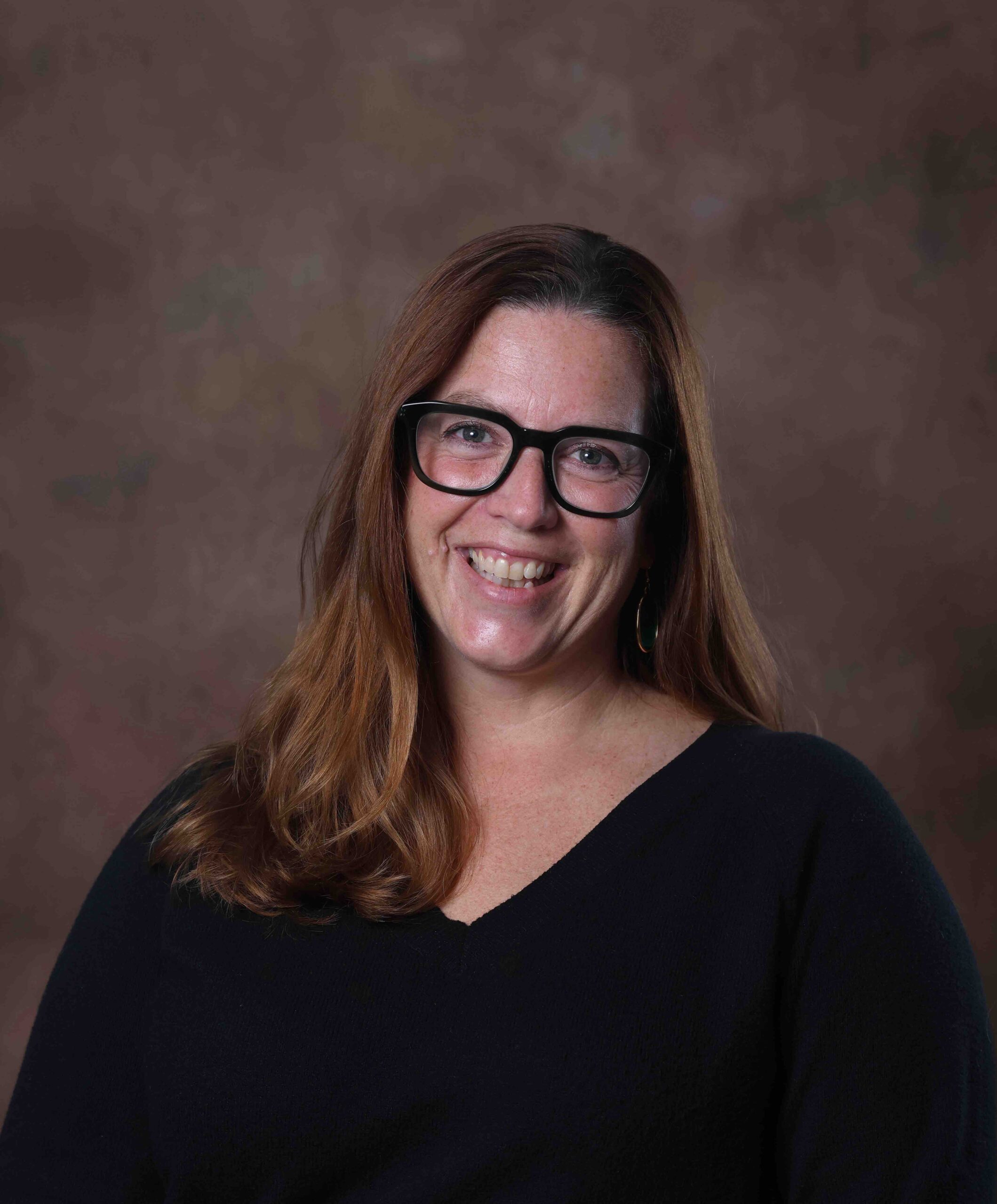
Kristie Gates Radford is a dedicated educator and International Baccalaureate (IB) Coordinator at Corning-Painted Post High School. Her career is defined by a commitment to academic rigor, equity, and holistic student development. She teaches IB English and Theory of Knowledge while serving on several district committees, including the Safe & Supportive Schools Committee. Radford also leads community-focused initiatives such as Hawks Thrive, a school-based food center, and sponsors student equity teams. Her efforts to create inclusive learning environments earned her the inaugural Equity Catalyst Award from Corning Incorporated.
She is the first recipient of the Carl and Cindy Hayden Quarry Farm Teaching Fellowship.
The first afternoon I spent at Quarry Farm as a fellow was surreal–I was less than five miles from my house and yet felt both leagues and centuries away. The first hour was spent investigating the house’s age and feeling both a great sense of responsibility and an uncanny giddiness that someone had actually left me alone in the space. It was February and I was incredibly disappointed that I couldn’t just live on the porch–recalling a summer book study, a visit as an undergrad, and a quick wander as a young mother looking for great fall pics of my handsome children. I do distinctly remember though, recognizing that the house had a spirit–something palpable. As I wandered from room to room marveling at the age and the stories hiding just below the surface, I could feel that unmistakable energy: a row of keys, books in their authentic placement, a dining room table ready for clinking glasses and the ‘ting’ of a fork and knife, a hum of conversation. Ultimately, with a distinct awareness that my week was short, I made a move to find what I could find, academically speaking. I stood in the door of the library, acknowledged its age and ran my fingers across the oak table I immediately recognized from Elmira College’s Hamilton Hall. And with that, started searching through books; eager to get my nerd on.
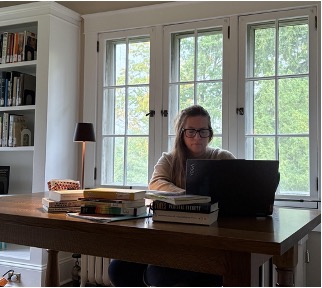
Radford at Work at Quarry Farm
(Photo Courtesy of Kristie Gates Radford)
By far, my favorite discovery was Dr. Kiskis’ library mixed into the collection on the second floor. He was one of my favorites and had introduced me to texts I hadn’t experienced and a thought process that my budding English Literature major was starting to tease into existence. His style of teaching was different from other Elmira College English Professors, like Dr. Schwartz, Dr. Minor, Dr. LaPointe–now, I can say it was much closer to the way I conduct my own classes. His engagement with students, and his obvious love of lit and of teaching made an impression on 19-year-old-me. The discovery that his library was housed at Quarry Farm was like stumbling into gold; I texted a fellow EC alum a photo of book spines and later, marginal notes. I savored those annotations– in some moments it felt as if I was once again engaging in Socratic discourse under Dr. Kiskis’ tutelage.
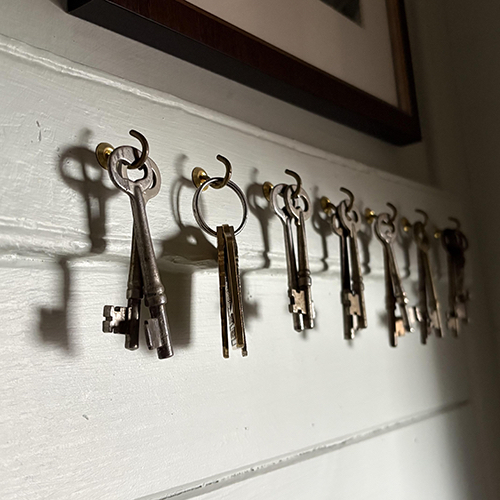
Keys in the Quarry Farm Pantry
(Photo Courtesy of Kristie Gates Radford)
As a local resident and a public-school educator, I offered to split my two-week stay across the seasons–allowing those who would travel further and whose schedules might be a bit more rigid to find their stay in consecutive weeks. This turned out to be a terrific decision–I spent my first week researching, planning, taking notes, and collecting evidence for my project. As the first Carl & Cindy Hayden Fellow, it felt important to both create a standard but also to carve out a process that made sense; the split in seasons and months allowed both growth and reflection. If my first week was for getting dirty and diving into criticism, my second week was for fine-tuning. And, as is true to my personal philosophy, and my approach to almost everything, I constructed, deconstructed, tore-down, and recreated my unit of instruction at least three times that second week.
The latter of the two stays spanned the last week of September and the first days of October–prime time in upstate New York. I had the benefit of a sound acquaintance with the library and perfect fall weather. My February dreams of existing on the porch were actualized, and I took distinctly less time marveling at the house. On the contrary, it felt like a personal space–something I was comfortable in and with; a space that could foster my growth as an educator. In my second stay, I spent little time downstairs. I started each day at the library table in the upstairs study, spent an hour or so midday on the porch or wandering the grounds and then settled back in for more research and rebuilding–windows open, fresh fall air at my back. The routine suited me and my exploration of text and development of an instructional unit.
The space, the Farm, the opportunity hold a liminal existence in my career as an educator. Likewise, they reignited my love of learning. Building a unit of instruction from conception to fruition allowed me to connect to Twain’s literature in a way I hadn’t previously thought of. It allowed me to connect spheres of my existence–collegiate me, investigating a text I had once read with a beloved professor, to the seasoned educator. It allowed space for reflection as well as growth.
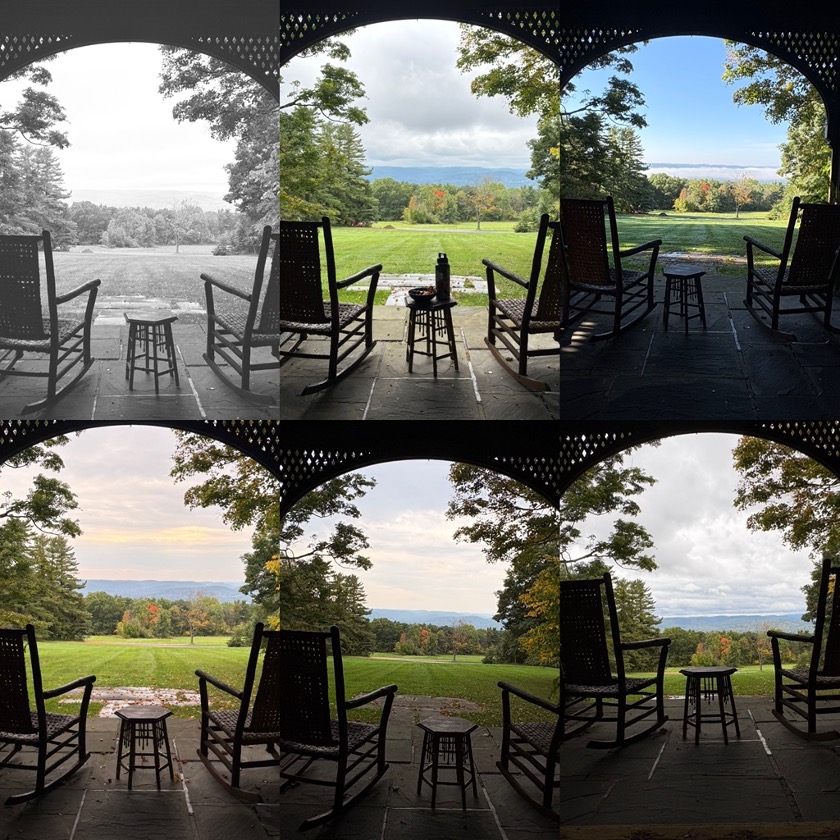
View from the Quarry Farm Porch
(Photo Courtesy of Kristie Gates Radford)