
The Center for Mark Twain Studies (CMTS) at Elmira College announced the schedule for the 2026 Park Church Summer Lecture Series, which takes place on Wednesdays throughout July at the historic Park Church. Located at 208 West Grey Street (Elmira), the lectures are free and open to the public. They begin at 7:00 p.m. and will be held on July 15 and July 22.
Mary Lemak will continue the lecture series with “Brockway’s Paddle: Institutional Violence and Press Protection at the Elmira Reformatory.”
The late-nineteenth saw expansion in both reform movements and public institutions in the United States. States around the country were giving women the right to vote, passing early labor laws to protect women and children, and dealing with an ever-changing and growing immigrant population. During this time, some progressives were also concerned with an oft overlooked population: incarcerated people. As a trial run of “the new penology,” progressives in the American Penology Association pushed for a brand-new facility in which they would focus on rehabilitation and reintegration instead of retributive punishment. Because of its rural locale but relative proximity to major cities, the New York legislature decided to build this facility in Elmira, New York. The Elmira Reformatory, as it was originally called, was founded with the intent to rehabilitate vulnerable youth and give them access to the skills and resources necessary to deter future crime. Instead of following its mission plan, the Reformatory quickly became a hotbed of poor conditions and gruesome violence. Its superintendent, Zebulon Brockway, originated the plan for the Reformatory. He became a highly controversial figure, bolstered by the New York Times and disparaged by the New York World. However, his support in the press allowed him to escape any consequences for the abuse he was almost single-handedly responsible for.
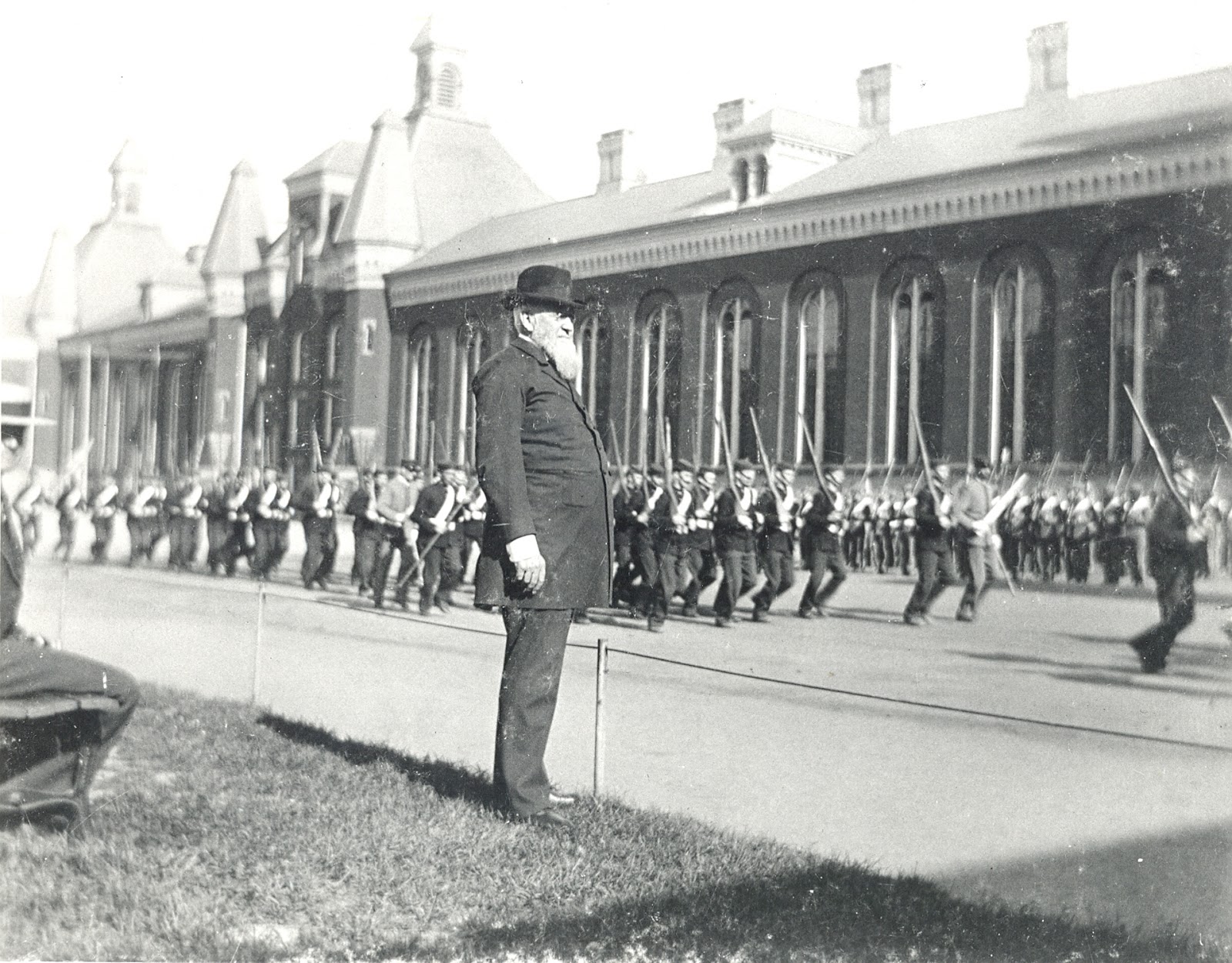
Photograph of Zebulon Brockway inspecting a parade. Courtesy of the Chemung County Historical Society
Mary Lemak is a Juris Doctor Candidate entering her final year at the University at Buffalo School of Law. She has a Bachelor’s of Arts in History from the University at Albany; she focused her senior honors thesis on the Park Church’s Reverend Annis Ford Eastman and Elmira’s Gilded Age politics. She currently works with incarcerated people on their post-conviction proceedings. Some of her clients are incarcerated in Elmira. Upon graduation, she hopes to continue her work in criminal defense in the Southern Tier.
Additional 2026 Park Church Summer Lectures:
- 7:00 p.m., Wed., July 22: “Mark Twain’s History of the Novel” Emily Gowen, University of Notre Dame
About The Park Church
Founded in 1846 by a group of abolitionists, including Jervis Langdon, Mark Twain’s father-in-law, The Park Church has been a strong presence in Elmira’s history. Some of its congregation were close friends and family members to Mark Twain, including Susan Crane, who donated flowers from Quarry Farm every Sunday. Known for its striking architectural features, The Park Church contained Elmira’s first public library and has a long history of charitable service to the Elmira community. Thomas K. Beecher, brother to Harriet Beecher Stowe and friend of Mark Twain, was the first minister at the Park Church and presided over its construction. Before its demolition in 1939, the Langdon Mansion was located directly across from the Park Church.
About The Trouble Begins Lecture Series
In 1984, the Elmira College Center for Mark Twain Studies initiated a lecture series, The Trouble Begins at Eight. The title came from the handbill advertising Mark Twain’s October 2, 1866 lecture presented at Maguire’s Academy of Music in San Francisco. The first lectures were presented in 1985. By invitation, Mark Twain scholars present lectures in the fall and spring of each year, in the Barn at Quarry Farm or at Peterson Chapel in Cowles Hall on Elmira College’s campus. All lectures are free and open to the public.