All Trouble Begins and Park Church Lectures are open to the general public at no charge.
A videorecording of all Trouble Begins and Park Church Lectures will be posted and archived in the Trouble Begins Lecture Archive.
The 2026 Trouble Begins and Park Church Lecture Series is made possible throught the generous support of the Mark Twain Foundation.
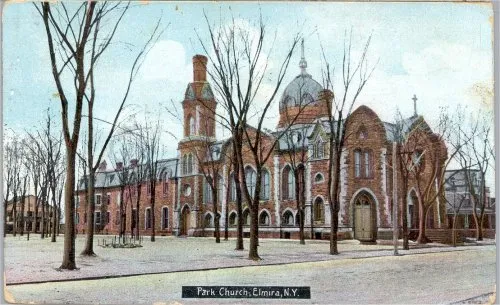
Founded in 1846 by a group of abolitionists, including Jervis Langdon, Mark Twain’s father-in-law, The Park Church has been a strong presence in Elmira’s history. Some of its congregation were close friends and family members to Mark Twain, including Susan Crane, who donated flowers from Quarry Farm every Sunday. Known for its striking architectural features, The Park Church contained Elmira’s first public library and has a long history of charitable service to the Elmira community. Thomas K. Beecher, brother to Harriet Beecher Stowe and friend of Mark Twain, was the first minister at the Park Church and presided over its construction. Before its demolition in 1939, the Langdon Mansion was located directly across from the Park Church.
The Park Church is located at 208 West Gray Street, Elmira, New York.
Wednesday, July 8 at The Park Church (7:00 PM)
Sexuality, Insanity, and the Problem of the Will: or, Pudd’nhead Wilson on Trial
Benjamin Bascom, West Virginia University
In May of 1868, the body of Cornelius Holmes was found bludgeoned to death in some woods nearby Plymouth, MA; the accused Samuel M. Andrews counterclaimed that his one-time friend had sexually assaulted him, leading Andrews to bash stones into Holmes’s face, killing him. The sudden onslaught of Andrews’s violence seemed to evince what the trial record assessed as his “temporary insanity,” or Mania Transitoria. This diagnosis became suggestive as Andrews apparently had no memory of the events though he did, through the course of the trial, accuse the deceased of having made previous unwanted advances. Disparities in age and class frame this story, with Holmes a wealthy bachelor in his 50s and Andrews a married day laborer in his 30s. These men had often traveled together, and the older fellow presented gifts and monetary necessities throughout their 16-year acquaintance that became something like a relationship. Circulating within the news and gossip of this tragedy are references to a will that Holmes left for Andrews, shortly before the murder, which bequeathed to the younger man an abundant inheritance. This temporal coincidence suggested a motivation for murder. After six months of trial, however, Andrews was found guilty only of manslaughter and sent to the state prison for 19 years, with his family’s history of mental illness used as evidence to support the decision. What this unusual trial brings forward are questions of inheritance and the multiple valences of will, where the term means both a legally binding document and a personal drive or inclination.
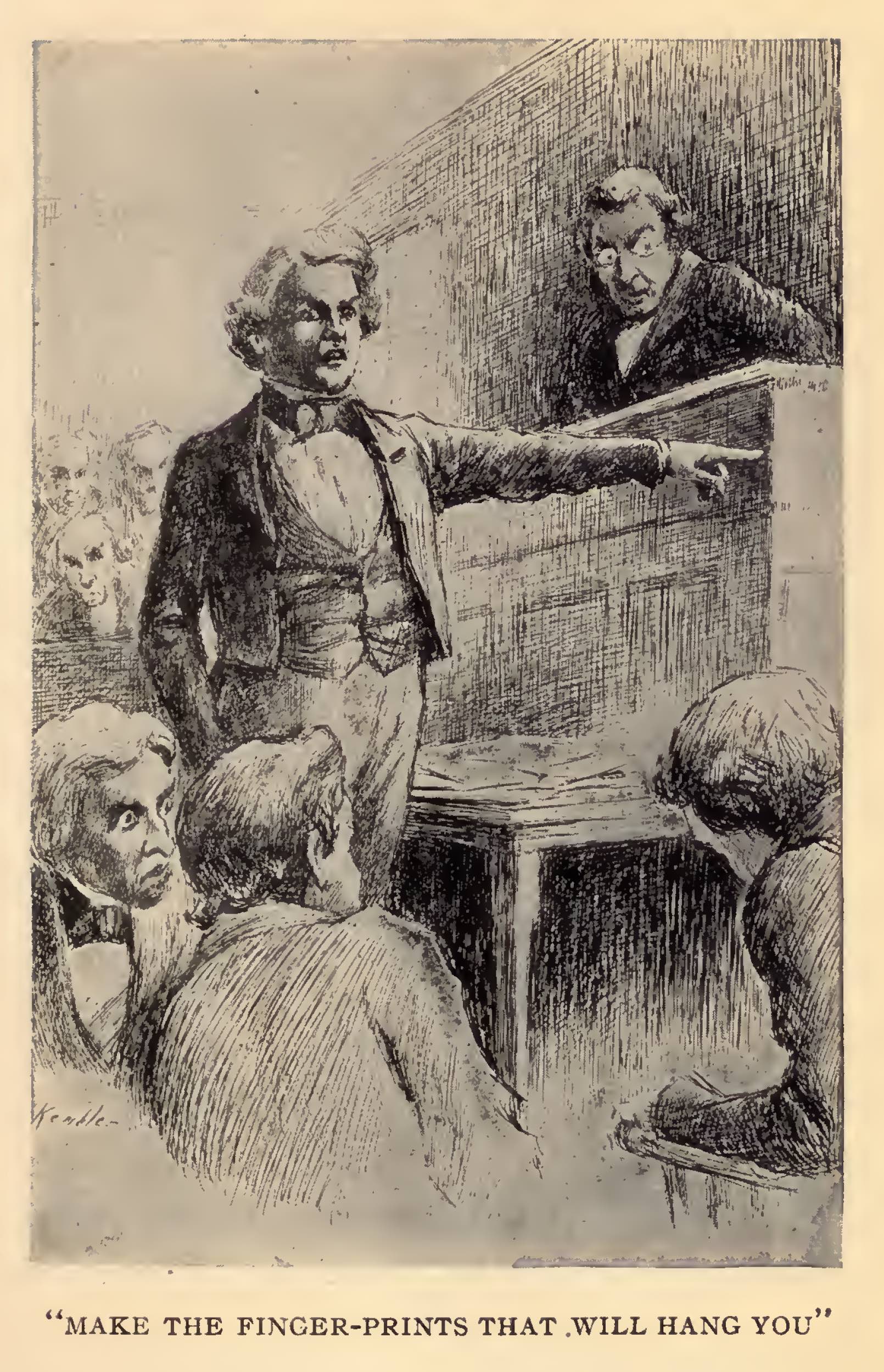
“Make the Finger-Prints That Will Hang You.”
Illustration by E.W. Kemble from Puddn’head Wilson and Those Extraordinary Twins. Édition de Luxe. American Publishing Company (1899) 220.
Wills, of course, abound in nineteenth-century American literature, most prominently in Pudd’nhead Wilson (1893), where Tom Driscoll is written in and out of inheritance, and he seemingly can’t help but self-sabotage over and over again. There is something compulsive to how this character unravels: he is represented as perpetually breaking and ruining his social and familial bonds, led inevitably to repeat self-destructive behavior. When the botched attempt to rob his uncle leads to murder, the “natal autograph” intervenes in the story and asserts Tom’s bodily legibility as superseding his agency—as speaking forth a truth that he (and Roxy) would rather have buried. The details in this novel become particularly suggestive when put into relation to the earlier legal case of Samuel Andrews’s conviction. Indeed, what juxtaposing this novel with the previous legal case provides is a way to think about the interrelation between desire and will, and the extremities of both that signal stepping beyond bounds—and into the category called insane. I argue that these conjoined stories suggest the intricate relation between sex and insanity to imagine what constitutes the will.
Ben Bascom is Assistant Professor of English at West Virginia University and teaches and researches early and nineteenth-century American literatures and contemporary LGBTQIA+ cultures. The research and writing for his first book, Feeling Singular: Queer Masculinities in the Early United States (Oxford UP, 2024), was supported by the National Endowment for the Humanities and tells an alternative account about the early US through focusing on outsiders who desired to belong but faced a series of exclusions that rendered their lives queer. He is working on a second book project that considers the relationship between what today gets called “mental health” and sexuality. Additionally, he co-edits with Christopher Hanlon ALH Review.
Wednesday, July 15 at The Park Church (7:00 PM)
“Brockway’s Paddle”: Institutional Violence and Press Protection at the Elmira Reformatory
Mary Lemak, University at Buffalo Law School
The late-nineteenth saw expansion in both reform movements and public institutions in the United States. States around the country were giving women the right to vote, passing early labor laws to protect women and children, and dealing with an ever-changing and growing immigrant population. During this time, some progressives were also concerned with an oft overlooked population: incarcerated people. As a trial run of “the new penology,” progressives in the American Penology Association pushed for a brand-new facility in which they would focus on rehabilitation and reintegration instead of retributive punishment. Because of its rural locale but relative proximity to major cities, the New York legislature decided to build this facility in Elmira, New York. The Elmira Reformatory, as it was originally called, was founded with the intent to rehabilitate vulnerable youth and give them access to the skills and resources necessary to deter future crime. Instead of following its mission plan, the Reformatory quickly became a hotbed of poor conditions and gruesome violence. Its superintendent, Zebulon Brockway, originated the plan for the Reformatory. He became a highly controversial figure, bolstered by the New York Times and disparaged by the New York World. However, his support in the press allowed him to escape any consequences for the abuse he was almost single-handedly responsible for.
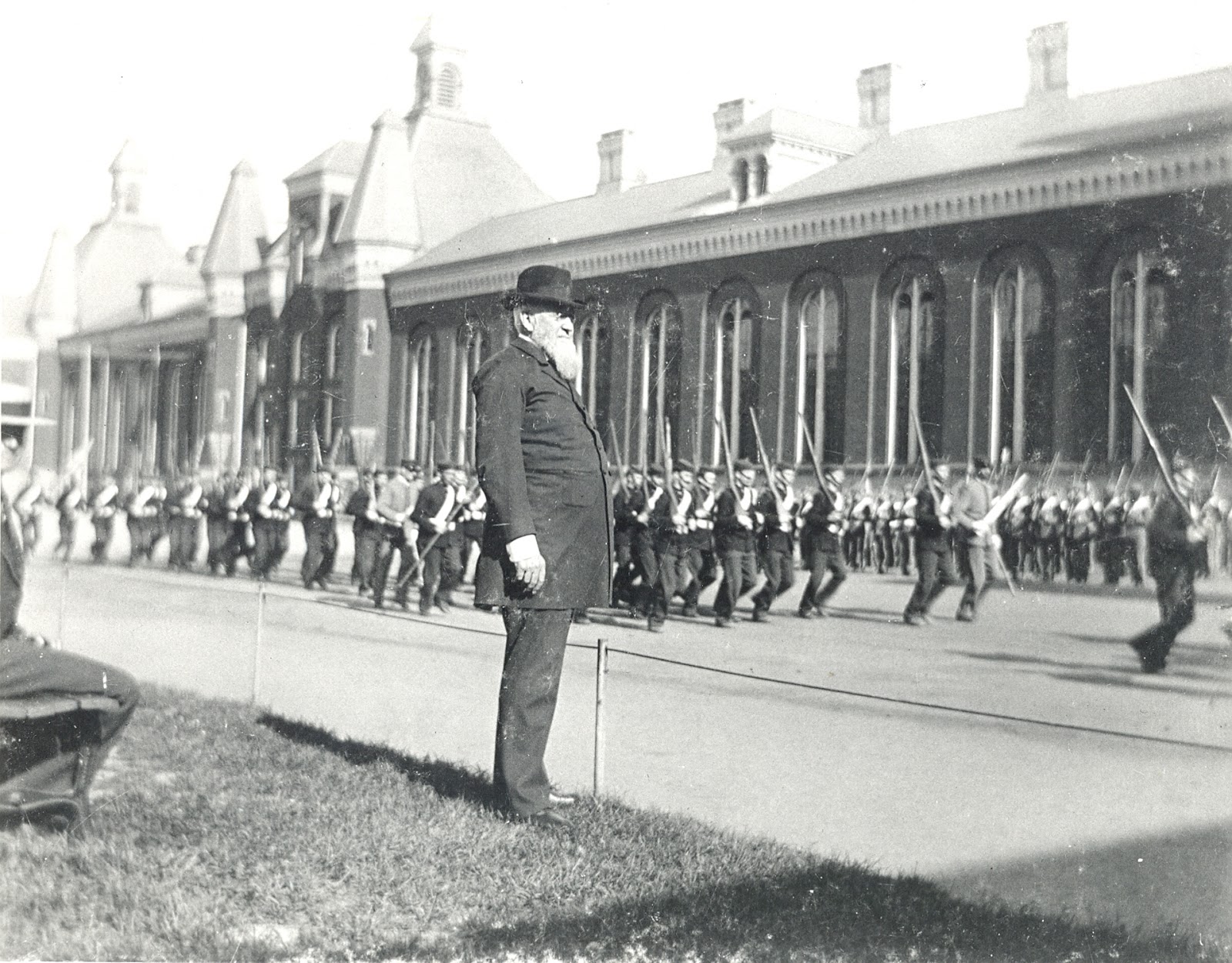
Photograph of Zebulon Brockway inspecting a parade. Courtesy of the Chemung County Historical Society
This talk contains two major arguments: first that Brockway was able to get away with abusing the residents of the Reformatory for so long because there was no oversight; and second that Brockway escaped punishment because of his support from the New York Times and its connections to the political elite. This talk first discusses Zebulon Brockway’s early life and career in the criminal justice system. It then outlines Brockway’s initial plan for the Reformatory. It then shifts and discusses press politics and the dynamic between the New York Times and New York World in the Gilded Age. This talk then provides a thorough analysis of the New York State Board of Charities’ investigation into the conditions and management at the Reformatory. It discusses the press’s reaction to the Board of Charities Investigation and details the subsequent Legislative investigation into the Reformatory’s Board of Managers. Finally, it discusses the lackluster aftermath of the investigations and discusses the modern reputations of Brockway and the Reformatory.
Mary Lemak is a Juris Doctor Candidate entering her final year at the University at Buffalo School of Law. She has a Bachelor’s of Arts in History from the University at Albany; she focused her senior honors thesis on the Park Church’s Reverend Annis Ford Eastman and Elmira’s Gilded Age politics. She currently works with incarcerated people on their post-conviction proceedings. Some of her clients are incarcerated in Elmira. Upon graduation, she hopes to continue her work in criminal defense in the Southern Tier.
Wednesday, July 22 at The Park Church (7:00 PM)
“Mark Twain’s History of the Novel”
Emily Gowen, University of Notre Dame
This talk will offer a reconsideration of Twain’s entire oeuvre as a response to the juvenilization, popularization, and material dissemination of canonical novels in the 19th Century United States, and will argue that his early immersion in the culture of reprinting and adaptation established the foundation for his approach to satire. Twain’s work offers us two useful historical vantage points through which to understand the long-term consequences of the way canonical texts were metabolized and canonized in early nineteenth-century print. First, Twain, like all the nineteenth-century authors, grew up reading reprinted and adapted European books, and thus understood canonical novels as always open to reconfiguration and Americanization. His career, however, took off long after the forms of publishing that sustained the profusion of adapted steady-selling novels had faded from view. Twain’s oeuvre thus offers us a retrospective theorization of the consequences of a finite period in U.S. American publishing, in which steady-selling British prose fictions were especially fungible literary resources. Moreover, many of Twain’s own works went on to become, in their own afterlives, contested, ambivalent, and interpretively unstable steady-sellers, enshrining and enacting the very ideas of literary history they set out to interrogate, and bringing the consequences of these print culture dynamics up to the present.
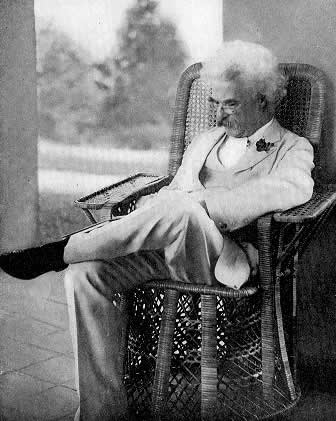
Photograph of Mark Twain reading on a porch. Photograph courtesty of the Mark Twain Papers and Project, UC Berkeley
Emily Gowen is an incoming Assistant Professor of English at the University of Notre Dame. She has previously taught at Boston University and Harvard University, and has held research fellowships at the McNeil Center for Early American Studies, the Library Company of Philadelphia, and The American Antiquarian Society. Her current book, Fictions in Print: Transatlantic Reprinting and The Popular Dissemination of the Novel in the 19th Century United States will be published by The University of Pennsylvania Press. Her work has appeared in ELH, American Literature, J19, and several other print and online journals.