The Center for Mark Twain Studies (CMTS) at Elmira College is honored to continue the 2026 Park Church Summer Lecture Series, which takes place on Wednesdays throughout July at the historic Park Church. Located at 208 West Grey Street (Elmira), the lectures are free and open to the public.
Emily Gowen will conclude the 2026 lecture series with “Mark Twain’s History of the Novel.” She is an incoming Assistant Professor at University of Notre Dame. Her current book, Fictions in Print: Transatlantic Reprinting and The Popular Dissemination of the Novel in the 19th Century United States will be published by The University of Pennsylvania Press.
This talk will offer a reconsideration of Twain’s entire oeuvre as a response to the juvenilization, popularization, and material dissemination of canonical novels in the 19th Century United States, and will argue that his early immersion in the culture of reprinting and adaptation established the foundation for his approach to satire. Twain’s work offers us two useful historical vantage points through which to understand the long-term consequences of the way canonical texts were metabolized and canonized in early nineteenth-century print. First, Twain, like all the nineteenth-century authors, grew up reading reprinted and adapted European books, and thus understood canonical novels as always open to reconfiguration and Americanization. His career, however, took off long after the forms of publishing that sustained the profusion of adapted steady-selling novels had faded from view. Twain’s oeuvre thus offers us a retrospective theorization of the consequences of a finite period in U.S. American publishing, in which steady-selling British prose fictions were especially fungible literary resources. Moreover, many of Twain’s own works went on to become, in their own afterlives, contested, ambivalent, and interpretively unstable steady-sellers, enshrining and enacting the very ideas of literary history they set out to interrogate, and bringing the consequences of these print culture dynamics up to the present.
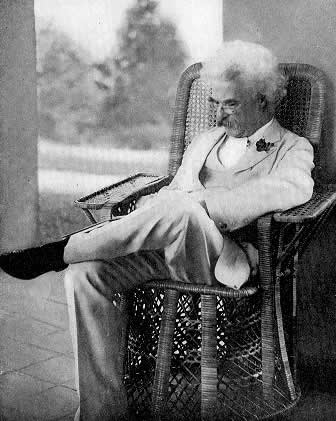
Photograph of Mark Twain reading on a porch. Photograph courtesty of the Mark Twain Papers and Project, UC Berkeley
Emily Gowen is an incoming Assistant Professor of English at the University of Notre Dame. She has previously taught at Boston University and Harvard University, and has held research fellowships at the McNeil Center for Early American Studies, the Library Company of Philadelphia, and The American Antiquarian Society. Her current book, Fictions in Print: Transatlantic Reprinting and The Popular Dissemination of the Novel in the 19th Century United States will be published by The University of Pennsylvania Press. Her work has appeared in ELH, American Literature, J19, and several other print and online journals.
About The Park Church
Founded in 1846 by a group of abolitionists, including Jervis Langdon, Mark Twain’s father-in-law, The Park Church has been a strong presence in Elmira’s history. Some of its congregation were close friends and family members to Mark Twain, including Susan Crane, who donated flowers from Quarry Farm every Sunday. Known for its striking architectural features, The Park Church contained Elmira’s first public library and has a long history of charitable service to the Elmira community. Thomas K. Beecher, brother to Harriet Beecher Stowe and friend of Mark Twain, was the first minister at the Park Church and presided over its construction. Before its demolition in 1939, the Langdon Mansion was located directly across from the Park Church.
About The Trouble Begins Lecture Series
In 1984, the Elmira College Center for Mark Twain Studies initiated a lecture series, The Trouble Begins at Eight. The title came from the handbill advertising Mark Twain’s October 2, 1866 lecture presented at Maguire’s Academy of Music in San Francisco. The first lectures were presented in 1985. By invitation, Mark Twain scholars present lectures in the fall and spring of each year, in the Barn at Quarry Farm or at Peterson Chapel in Cowles Hall on Elmira College’s campus. All lectures are free and open to the public.