The Center for Mark Twain Studies (CMTS) at Elmira College kicked off the 2026 Fall Trouble Begins Lecture Series last night. The lectures take place on Wednesdays throughout October at Quarry Farm. Located at 131 Crane Road (Elmira), the lectures are free and open to the public. The next lecture in the 2026 Fall series will take place on Wendesday, October 21.
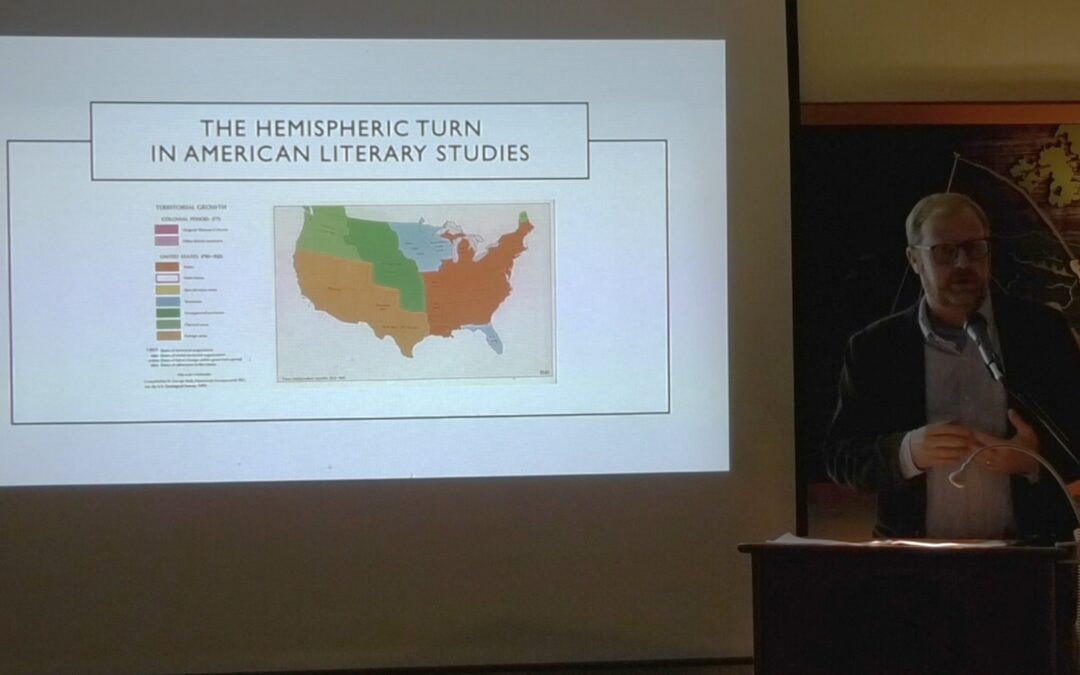
Todd Nathan Thompson presented “Mark Twain: Hemispheric Humorist.” Thompson is Professor of English at Indiana University of Pennsylvania.
Mark Twain is widely considered to be America’s greatest humorist; after all, the Kennedy Center award named after him is called “The Mark Twain Prize for American Humor.” But “America” is not a nation; rather, it is a hemispheric constellation of two continents connected by an isthmus, plus over 7,000 islands in the Caribbean. So, if we took a hemispheric instead of a nation-based view of Mark Twain and his humor? After all, Samuel Clemens knew the Western Hemisphere better than most. He cut his comic teeth in Nevada and California, which only two decades prior had been part of Mexico. He crossed the Central American isthmus multiple times, using both the Nicaragua and Panama routes. He loved the North Atlantic island of Bermuda, visited Cuba, and as a young man dreamed of moving to Brazil to make his fortune in cocaine. As a writer, Mark Twain mocked “ugly American” travelers in Nicaragua and pilloried Secretary of State William Seward’s post-war attempts to purchase Alaska and Caribbean islands almost three decades before he famously announced himself an anti-imperialist. In short, another way to view Samuel Clemens as an American traveler and Mark Twain as an American comic writer is to see both as comic cosmopolitans interested in overlapping, conflicting cultures and geopolitics of the Americas.
I will analyze several of Twain’s early-career comic writing about the Americas, including his satiric newspaper writings about U.S. imperial interest in St. Thomas, Puerto Rico, and Alaska, as well as his travel writing for the Alta California about his 1866 trip across the isthmus of Nicaragua. These writings reveal Twain’s awareness of the interconnectedness of different locations in the Americas as well as his savvy about U.S. imperial ambition across the hemisphere.
Reading Twain hemispherically also reminds us that the nineteenth-century American imagination of which territories would or would not come to count as part of the U.S. was far from settled. Like other nineteenth-century American humor, Twain’s work captured and stoked competing excitement and anxiety surrounding expansionism amid animated debates about the annexation of foreign territories, including Cuba, Nicaragua, and parts of Mexico and Canada. Beyond Twain, a hemispheric approach has ramifications for American humor studies, which has traditionally and myopically framed American humor as fomenting a nation-building, otherwise ineffable essence of American character.
Todd Nathan Thompson is Professor of English at Indiana University of Pennsylvania and Director of the Cook Honors College. He is a Contributing Editor to Studies in American Humor and Executive Director of the American Humor Studies Association. Todd is author of A Laughable Empire: The US Imagines the Pacific World, 1840-1890 (Penn State University Press, 2023) and The National Joker: Abraham Lincoln and the Politics of Satire (Southern Illinois University Press, 2015). His work has also appeared in American Periodicals, Scholarly Editing, Early American Literature, ESQ, Nineteenth-Century Prose, Teaching American Literature, the Mark Twain Annual, and elsewhere. His current book project is tentatively titled “Manifest Jestiny: Comic Cartography and Humor as US Foreign Policy, 1840-1870.”
The 2026 Fall Trouble Begins Lecture Series Schedule. All lectures start at 7:00 p.m., at the Barn at Quarry Farm, and are free and open to the public.
- Wednesday, Oct. 21: “Mark Twain’s Election Advice: Vote Your Conscience! Elect Candidates of Integrity Who Put Your Country’s Interest above Party Loyalty and Aggrandizement” by Donald T. Bliss, Independent Scholar
- Wednesday, Oct. 28: “The Mundane Transcendence of Mark Twain’s Late Style” by Ray Horton, Murray State University
About The Trouble Begins Lecture Series
In 1984, the Elmira College Center for Mark Twain Studies initiated a lecture series, The Trouble Begins at Eight lecture series. The title came from the handbill advertising Mark Twain’s October 2, 1866 lecture presented at Maguire’s Academy of Music in San Francisco. The first lectures were presented in 1985. By invitation, Mark Twain scholars present lectures in the fall and spring of each year, in the Barn at Quarry Farm or at Peterson Chapel in Cowles Hall on Elmira College’s campus. All lectures are free and open to the public.