“Quarry Farm Senses” (A Quarry Farm Testimonial)
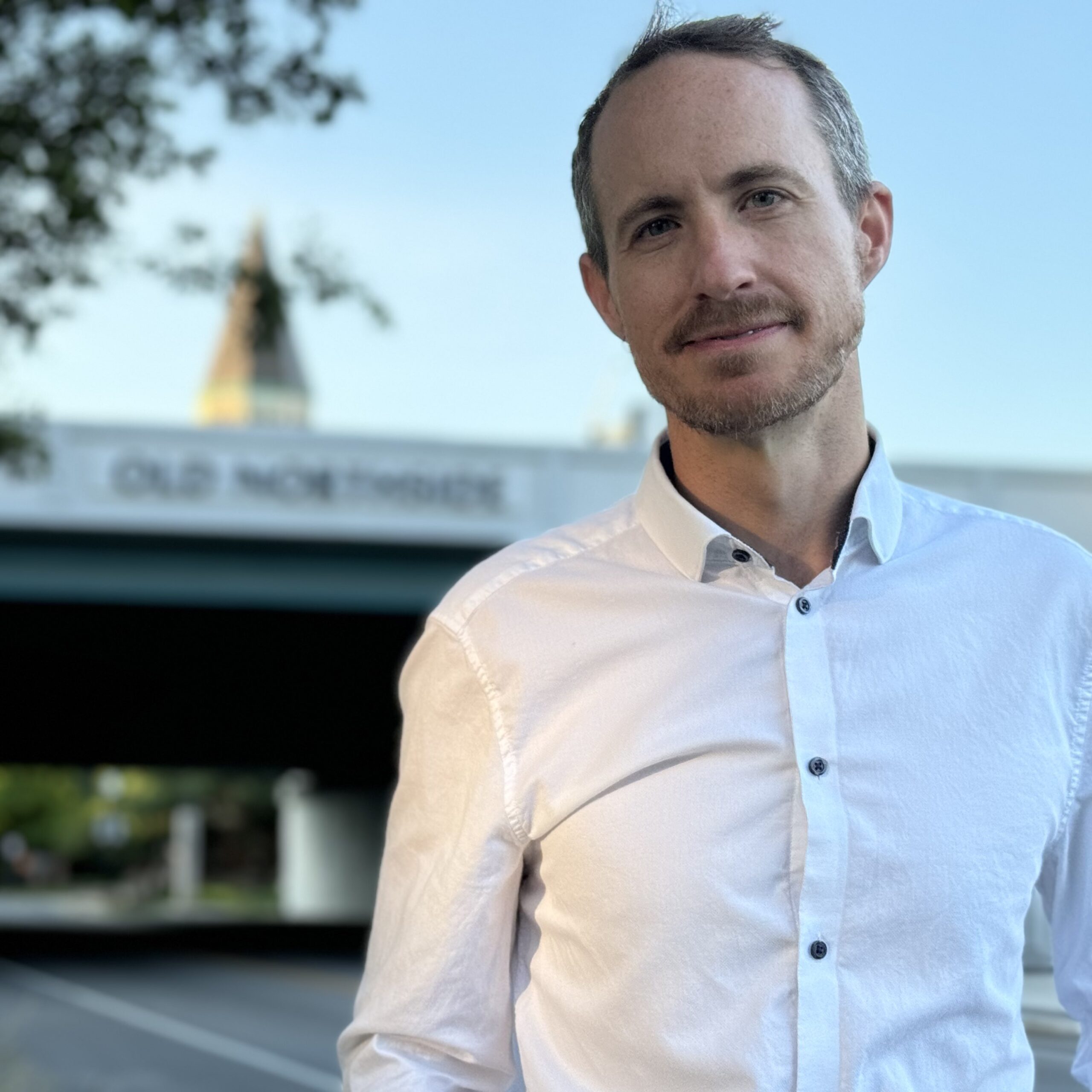
Ben Bascom is a scholar and teacher of early and nineteenth-century American literature and queer studies, and an Assistant Professor of English at West Virginia University. His book Feeling Singular: Queer Masculinities in the Early United States (Oxford UP, 2024) tells an alternative account of the early US republic through focusing on the failed and thwarted desires of a series of marginal and eccentric individuals who left behind neglected life narratives. His scholarship attends to the relations among textual materiality, archival preservation, and iconicity, and has been supported by fellowships at the American Antiquarian Society, The Library Company of Philadelphia, and the Clements Library at the University of Michigan, among others. He currently serves as the co-editor of American Literary History’s ALH Review.
Professor Bascom particpated in the 2026 Park Church Summer Lecture Series. You can find his lecture here:
- Ben Bascom, “Sexuality, Insanity, and the Problem of the Will: Or Pudd’nhead Wilson on Trial” (July 8, 2026 – The Park Church)
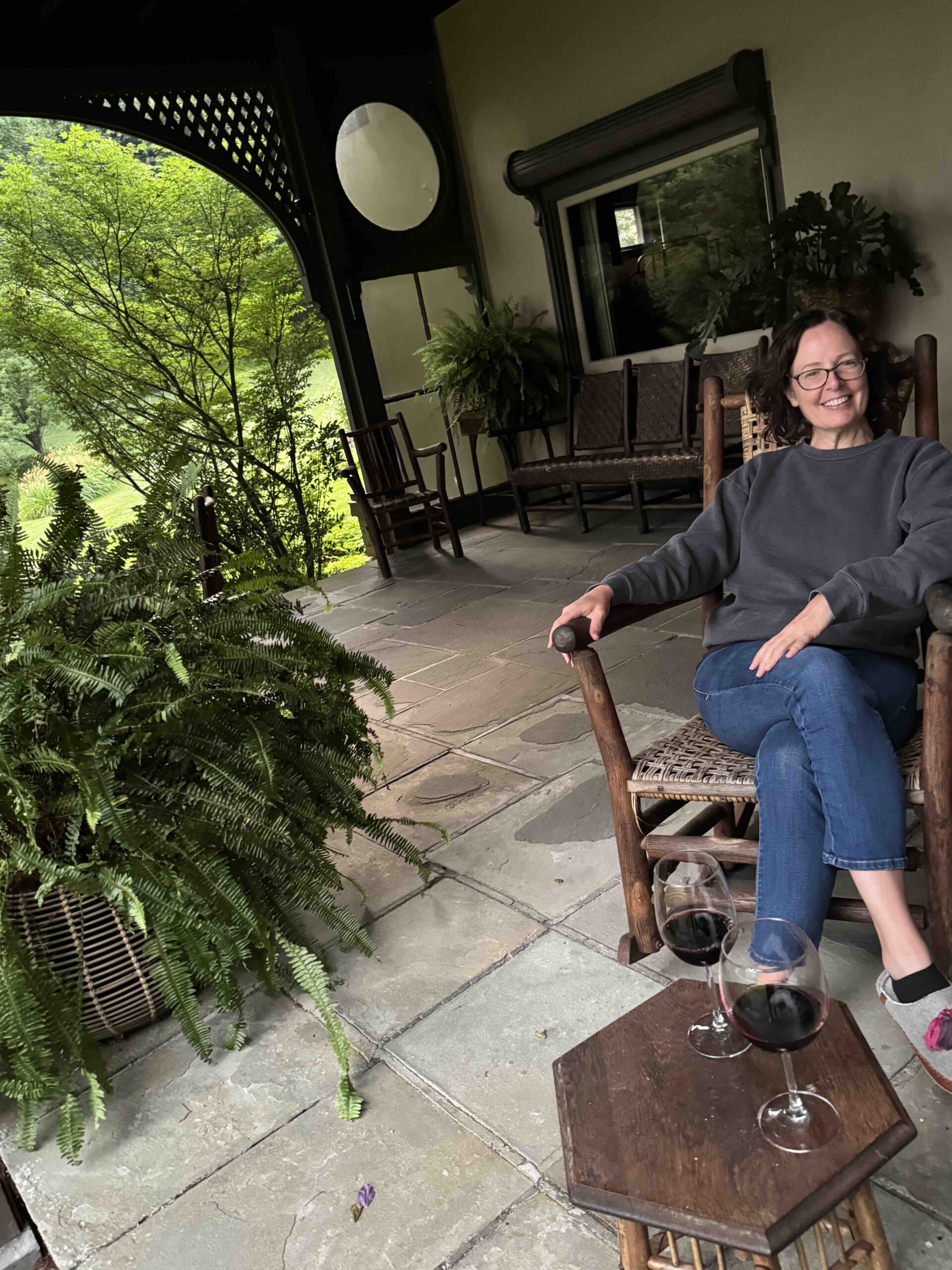
Frogs sing in the trees. Orchestral evenings. A chorus of wrens open the morning. My life at Quarry Farm was patterned after the sounds that my ears inclined toward, in the quiet mornings and reflective evenings, as I would sit outside and sip my morning coffee or share an evening glass of wine with my friend Katy Didden, a poet I invited to join me. I had thought having company would be ideal while participating in the generous research fellowship offered by the Center for Mark Twain Studies, and so in addition to Katy several other friends passed through on their summer travels. We would share a patio meal and talk about the work we were doing, from landscape architecture and early American literature to poetics and political science.
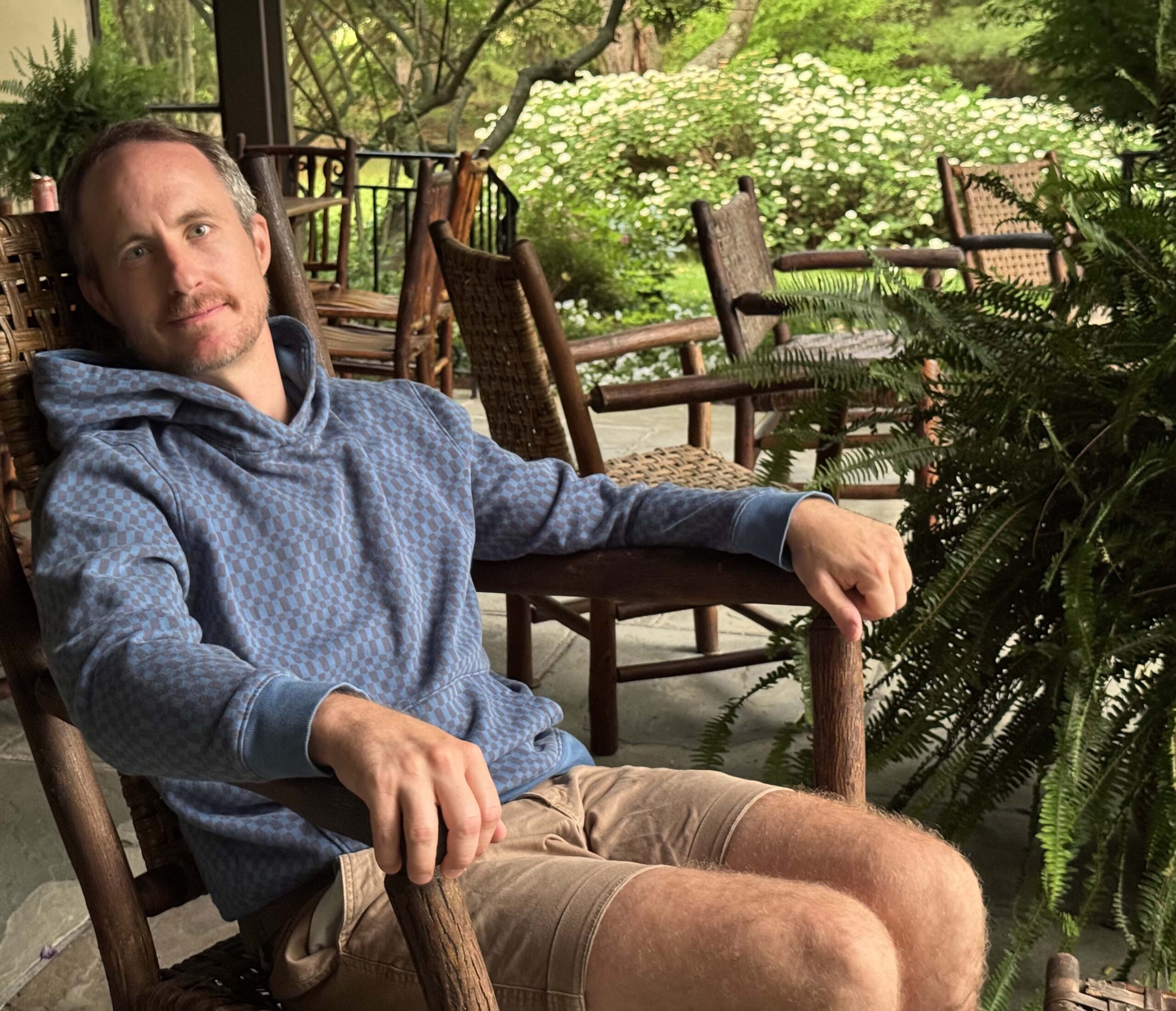
Photo above: Author sitting in the wooden rocker on the lovely front porch of Quarry Farm. (Courtesy of Katy Didden)
Photo to the right: Poet Katy Didden, enjoying the summer evening (Courtesy of Ben Bascom)
When living in community with a poet, one learns how to attend their senses to the sonorous world, and so I listened attentively. It was Katy who pointed out the welcoming portrait of Susan Langdon Crane before the back staircase, across from one of Mark Twain. In our imagination we felt the continuing spirit of Susan, the sister-in-law to the famous author, as we sat in company with others. We imagined how it would sound to be welcomed by her to this seasonal country house that she transformed into a year-round home. Although I could be accused of romanticizing our two weeks, there is something enchanting about living in a space dedicated for reading, writing, and thinking: and so, to be able to perform as temporary hosts, rounded out the fantasy.
My research into mental health and sexuality in the nineteenth century can often become quite stark and depressing, and so the reprieve to community that syncopated my upstairs’ reading and writing was invigorating. I developed this interest in the psychologies of interiority while grappling with stories from my own family history. For instance, an account of my maternal grandfather being institutionalized for six months at age 25, after returning from WWI, captivated me as a young adult. While at Quarry Farm I read all I could about the youngest child of Samuel and Olivia Clemens, Jean, who spent time in sanitoriums and asylums. I poured over the figurative tropes of insanity that loom large in Twain’s late writing. My scholarship considers where society positions those individuals that are deemed unable to conform to its norms or to circulate within its conventions, and the figurations of mental health and so-called insanity are very important to those stories.
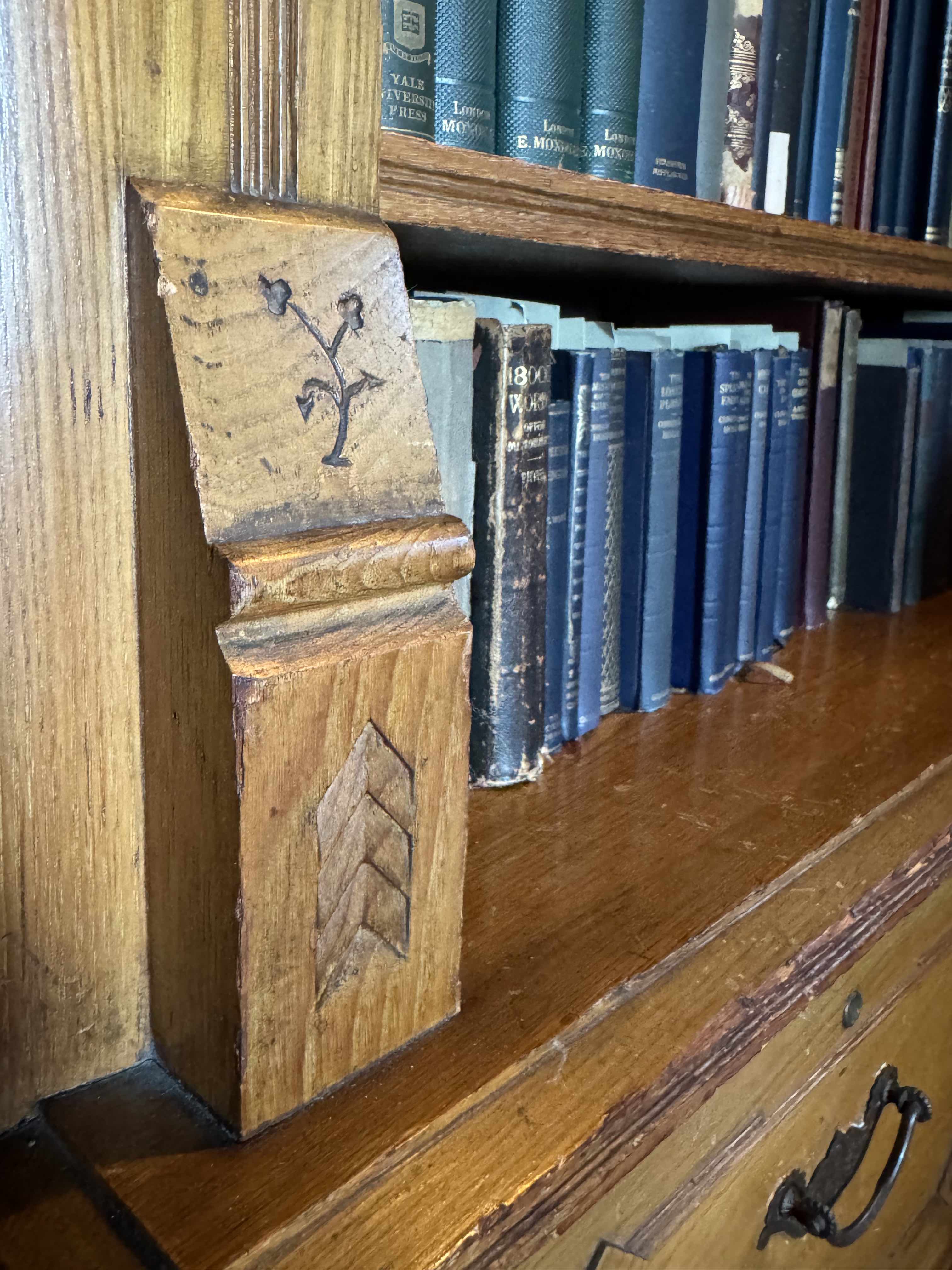
Photograph of the woodwork in the Quarry Farm library
(Courtesy of Ben Bascom)
One of the oldest definitions for mental illness—lunacy, a very outdated term, but one interesting for my reflections here—is described as associated with the night sky. Attributed to the moon’s phases, mental illness according to its etymology has been imagined as episodic, seasonally inflected by the waxing and waning of that orbiting sphere. Perhaps the assigning of causes for what the Oxford English Dictionary describes as “[e]xtreme or reckless foolishness; wild irrationality; eccentricity, absurdity, delusion”—and placing them far out of reach, in the heavens—provided a sense of peace or complacency. Explaining the inexplicable can often do that.
One evening—near our last—we perused the contents of the downstairs library and found a book called The Friendly Stars (1907) by Martha Evans Martin, the cover displaying a beautiful embossing of the Big Dipper. Katy is working on a poem about a massive telescope in Arizona and what its production enables and occludes. While discussing her poem and meandering through the book, I thought of Walt Whiman’s piece about the “Learn’d Astronomer” and the speaker’s impulse to leave the stuffy lecture and see the night sky firsthand; I reflected on Edgar Allan Poe’s early sonnet “To Science” where the speaker personifies a mode of invasive inquiry that “alterest all things with thy peering eyes!” and “whose wings are dull realities!” The imaginative realm can be such a balm to the brutality of fact. I can’t help but think of that evocative moment when Huck and Jim casually discuss whether stars are “made” or “just happened” when they are alone together on the raft, a momentary reprieve.
Reading is often considered a way to escape pressing realities. My last evening, alone, I found the house’s copy of The Education of Henry Adams (1918) and pulled it from the shelf, sitting down at the nearby long table to pour over it into the late evening hours under the lamplight. I turned to the chapter titled “The Dynamo and the Virgin,” where Adams reflects on the gendered representation of power and force at the 1900 Paris Exhibition. Fifteen years after his wife Marian Hooper Adams—affectionately called Clover—had killed herself, Adams discusses feeling “his historical neck broken by the sudden irruption of forces totally new.” There is something frenetic to how Adams describes things in this chapter. Clover had been an accomplished amateur photographer, and though Adams does not talk directly about his absent companion in his strange autobiography, one gets the sense that she functions as a type of model for how he narrates the creative and productive “power of sex” that, in the US, “was as far as possible sexless.” I’m still working over what all this means, though I thankfully was able to elaborate some of this argument at the generative Park Church lecture series.
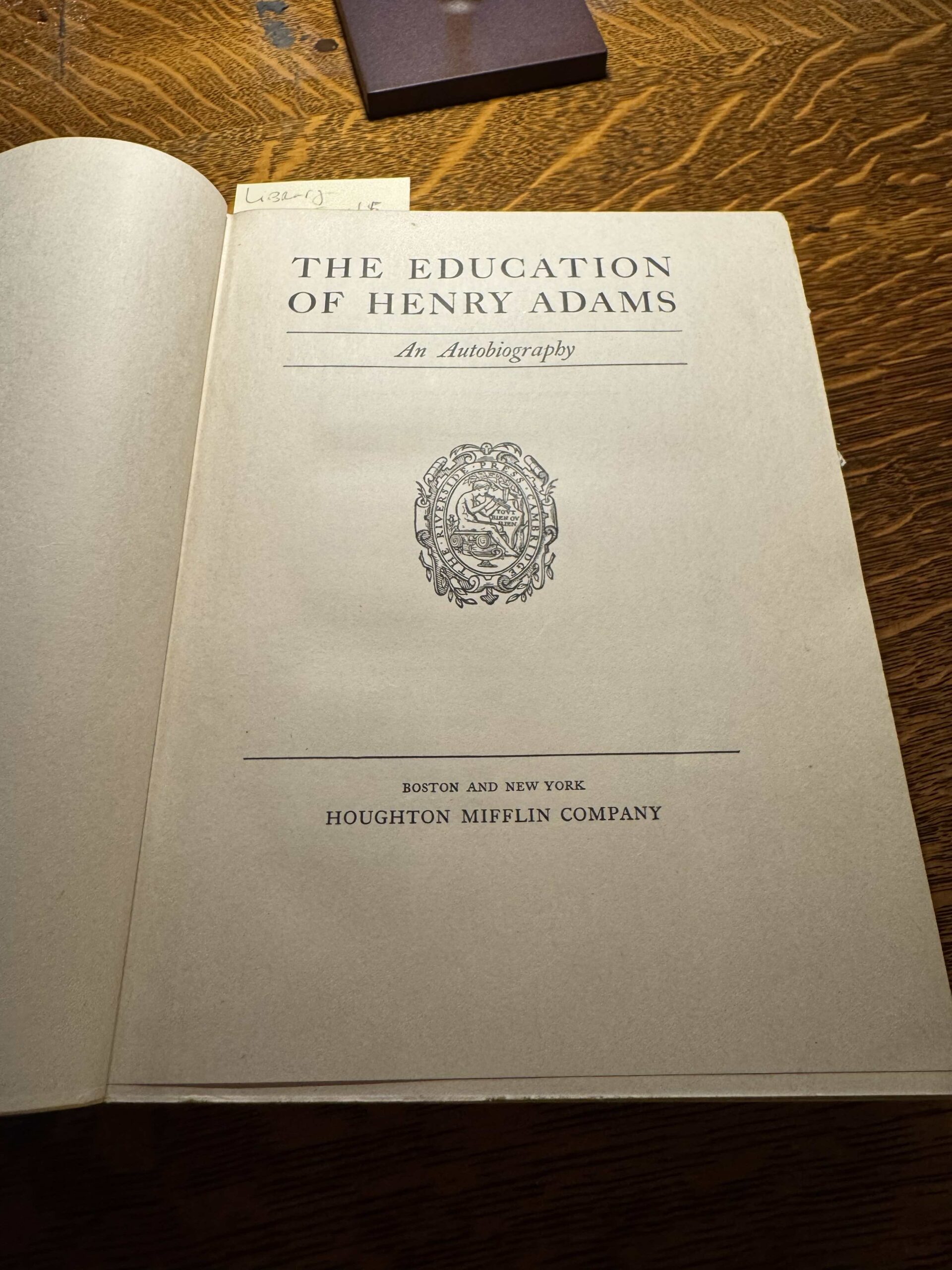
(Courtesy of Ben Bascom)
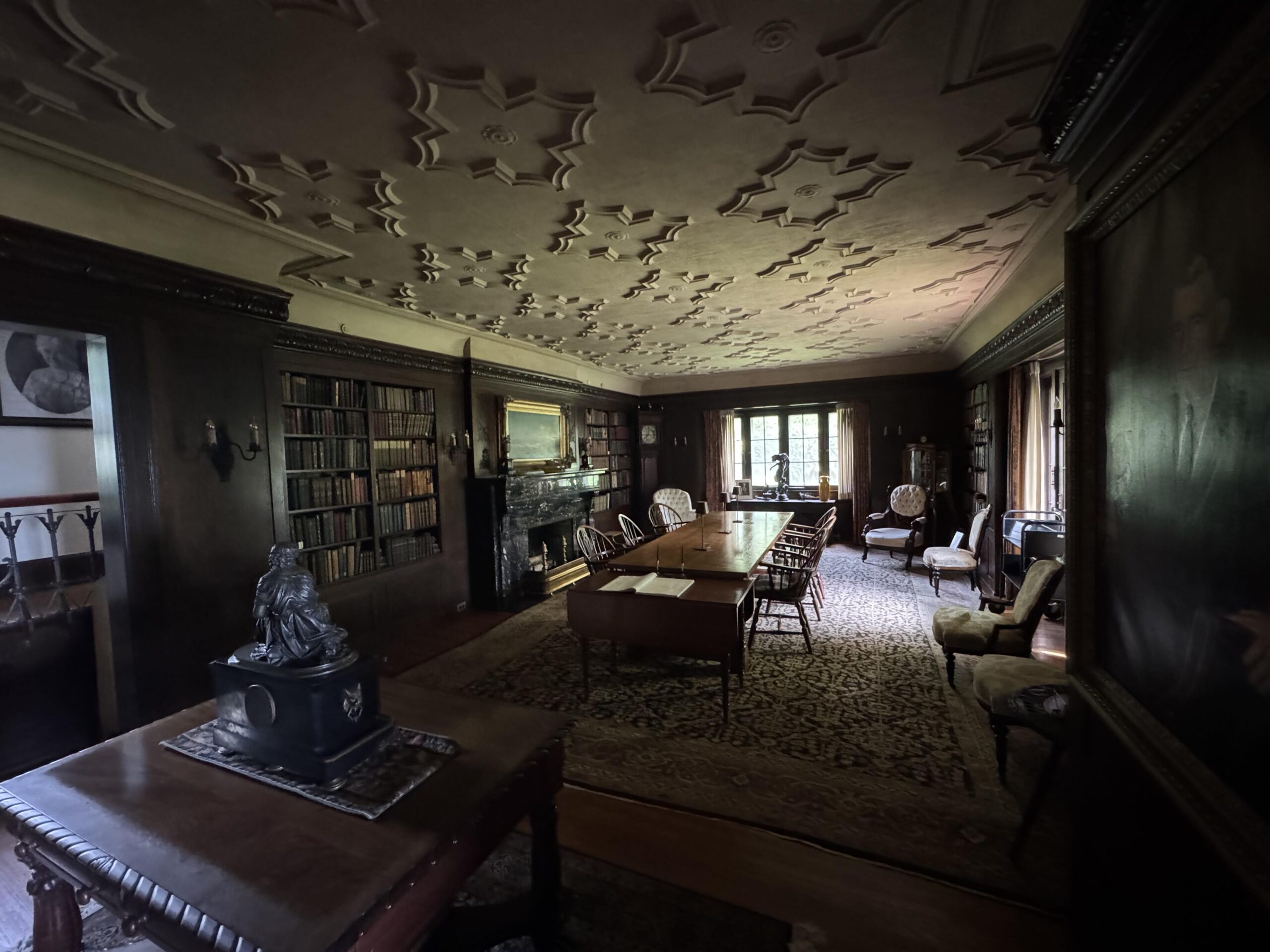
Quarry Farm Library (Courtesy of Ben Bascom)
I want to conclude by returning to the opening salvo on the senses. Although the sounds of Elmira’s amphibians and avians are faint impressions, especially while I sit at a different desk to write out my memories from months ago, I am newly attuned to the pitters and patters of West Virginia: the cardinal’s truculent chirp and hooded warblers making merry, the echoes and creaks of a different home, but one that has a window that allows me to gaze wistfully to a patio, one that reminds me that even here I can take a step outside and reorient my senses.
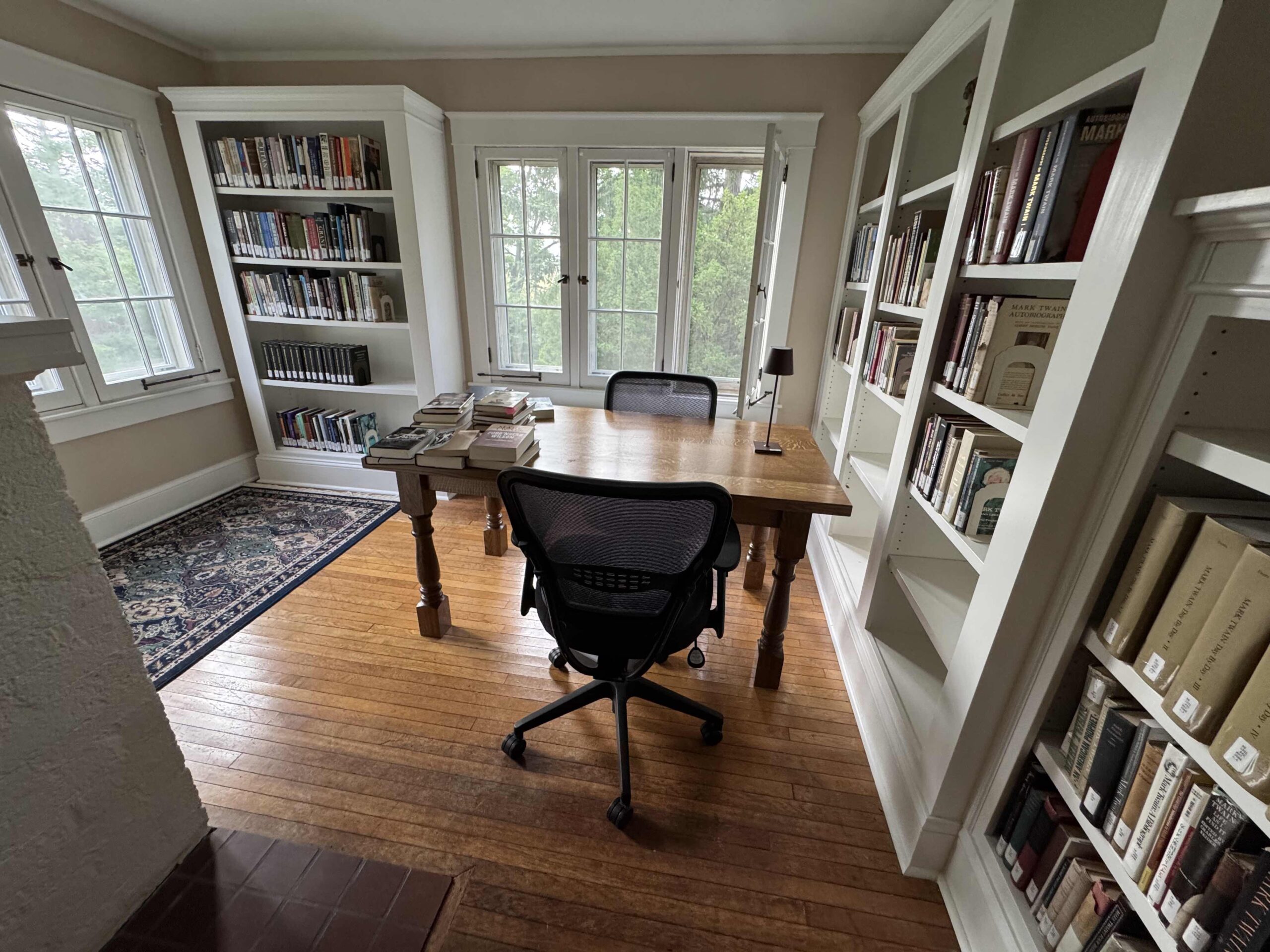
Second floor desk where the author would read in the morning
and write in the afternoon (Courtesy of Ben Bascom)
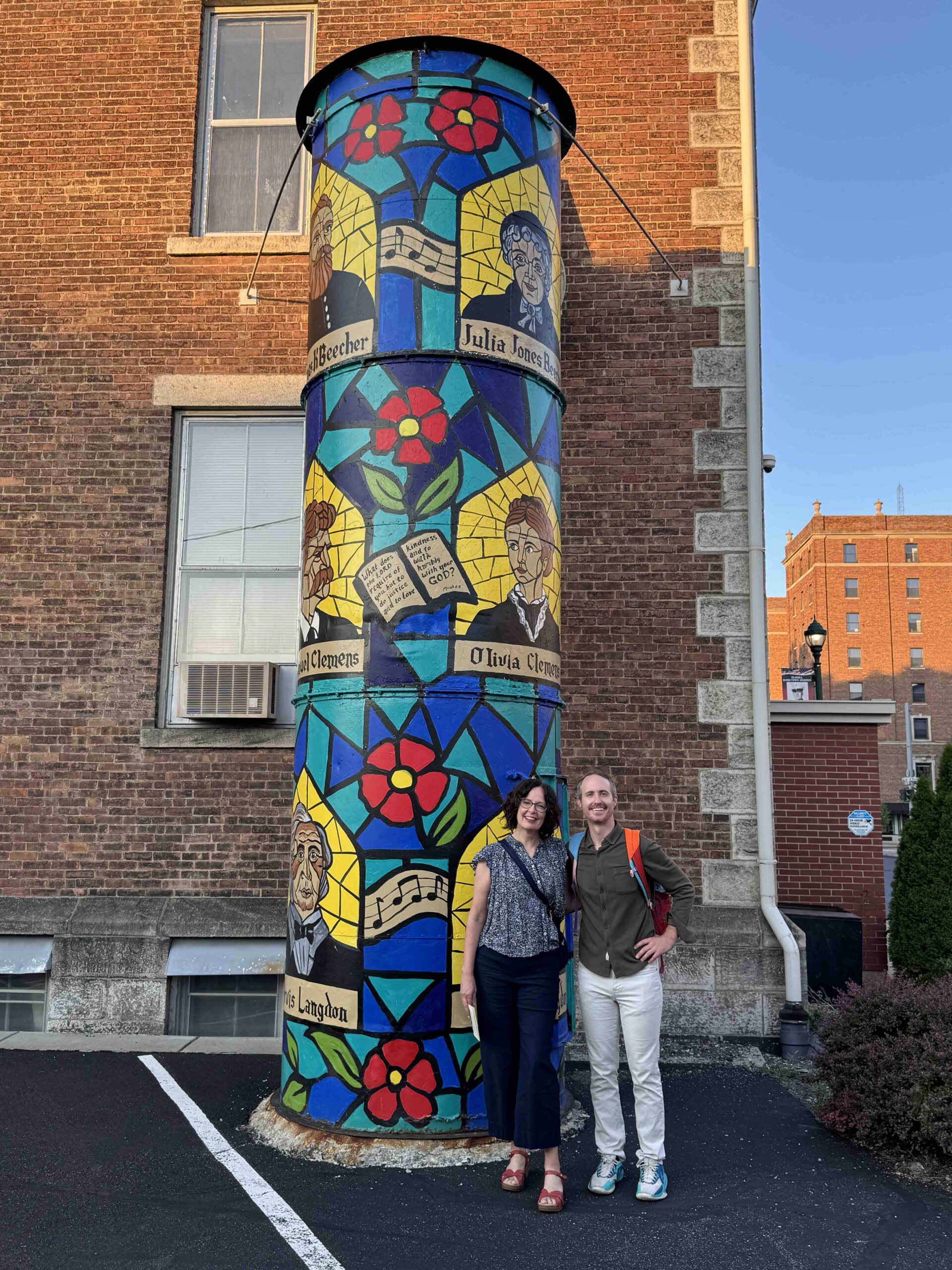
Photograph of the author and Katy Didden at the Park Church after the author participated in the 2026 Park Church Summer Lecture Series.
(Courtesy of Ben Bascom)